Purpose
What this drill trains, and why it matters.
The T-Drill is the Neural Window's most complete agility test because it demands every movement skill the window develops: forward sprint, lateral shuffle, backpedal, and change of direction, all in a single continuous rep. It is both a training drill and the benchmark assessment for agility readiness in the 7- to 12-year-old athlete.
What makes the T-Drill appropriate for the Neural Window (and not just for older athletes) is that running it at 70 to 80 percent effort keeps the focus on mechanics rather than time. At this age, the goal is not a fast T-Drill time. The goal is a clean T-Drill. Low hips at every cone. True lateral shuffle. No crossover. A backpedal that stays athletic rather than collapsing into a backward run.
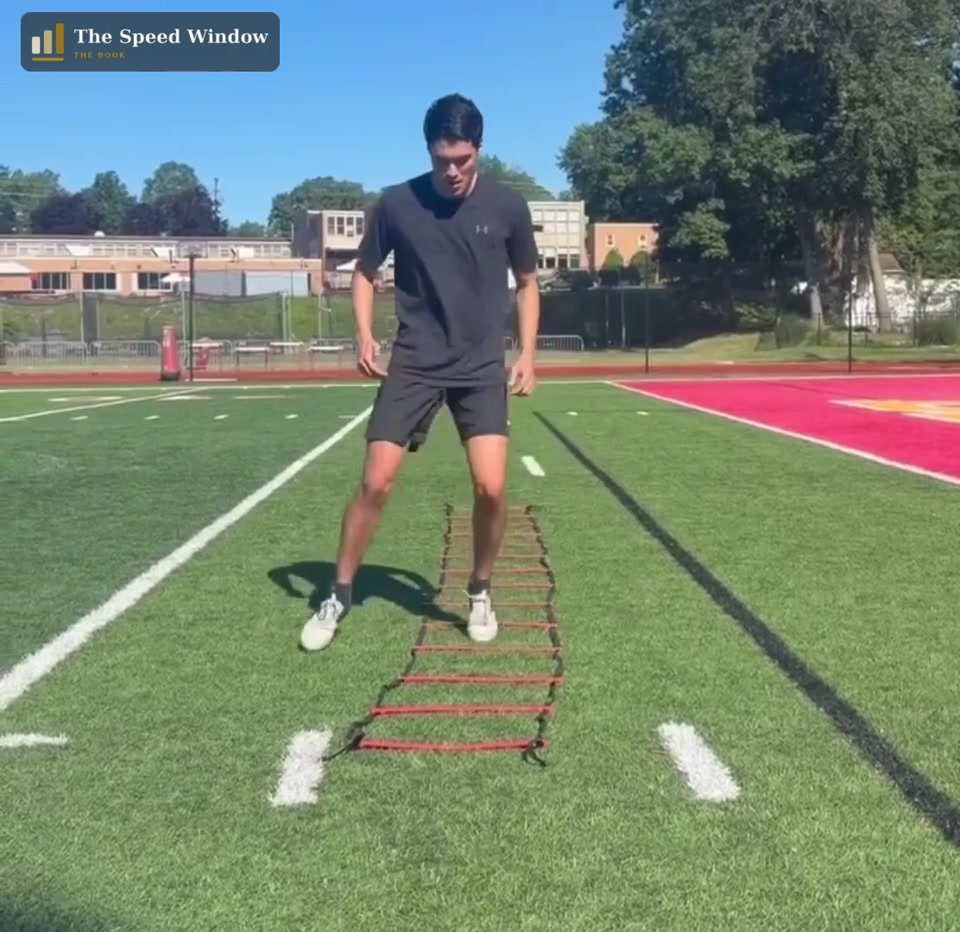
Introduce the T-Drill only after the Lateral Shuffle, Star Drill, and ladder patterns are established. The T-Drill is the integration point. It doesn't teach new mechanics, it demands that all the mechanics learned in the preceding drills work together under a more complex movement demand.
Setup
How to position your athlete before the first rep.
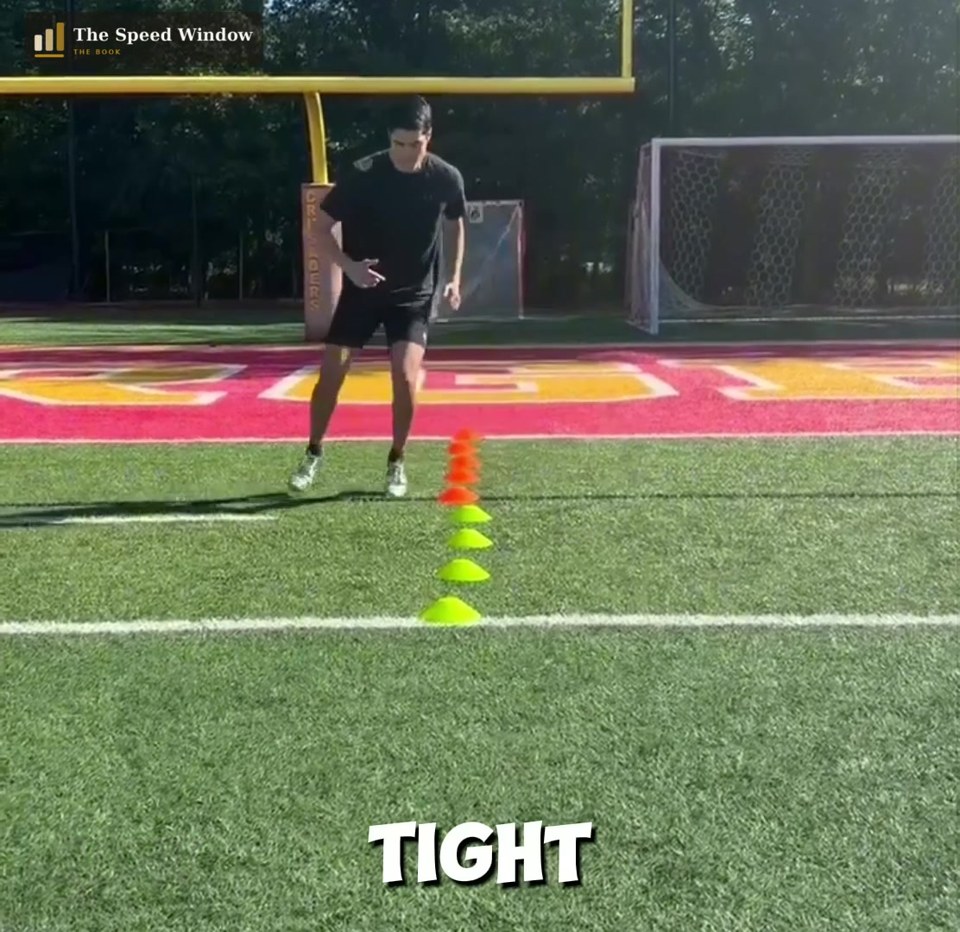
Set four cones in a T-shape
Place one cone at the base of the T (start/finish). Place one cone 10 yards straight ahead (top of the T). Place one cone 5 yards to the left of the top cone and one cone 5 yards to the right. The three top cones form a horizontal line 10 yards from start.
Athlete starts at the base cone
Athletic stance, facing the top center cone. The first movement is always a straight sprint forward. Begin from a two-point stance (no crouching start) to keep the movement pattern simple and consistent.
Walk through the full pattern before any timed or speed attempt
Walk: sprint forward, shuffle left to left cone, shuffle right to right cone, shuffle back to center, backpedal to start. Every athlete should walk through at least once before building to speed.
Execution
The drill, step by step.
Sprint forward to the center top cone: 10 yards
Full sprint, driving the arms. Touch the cone at the top with the right or left hand (alternate grip each rep).
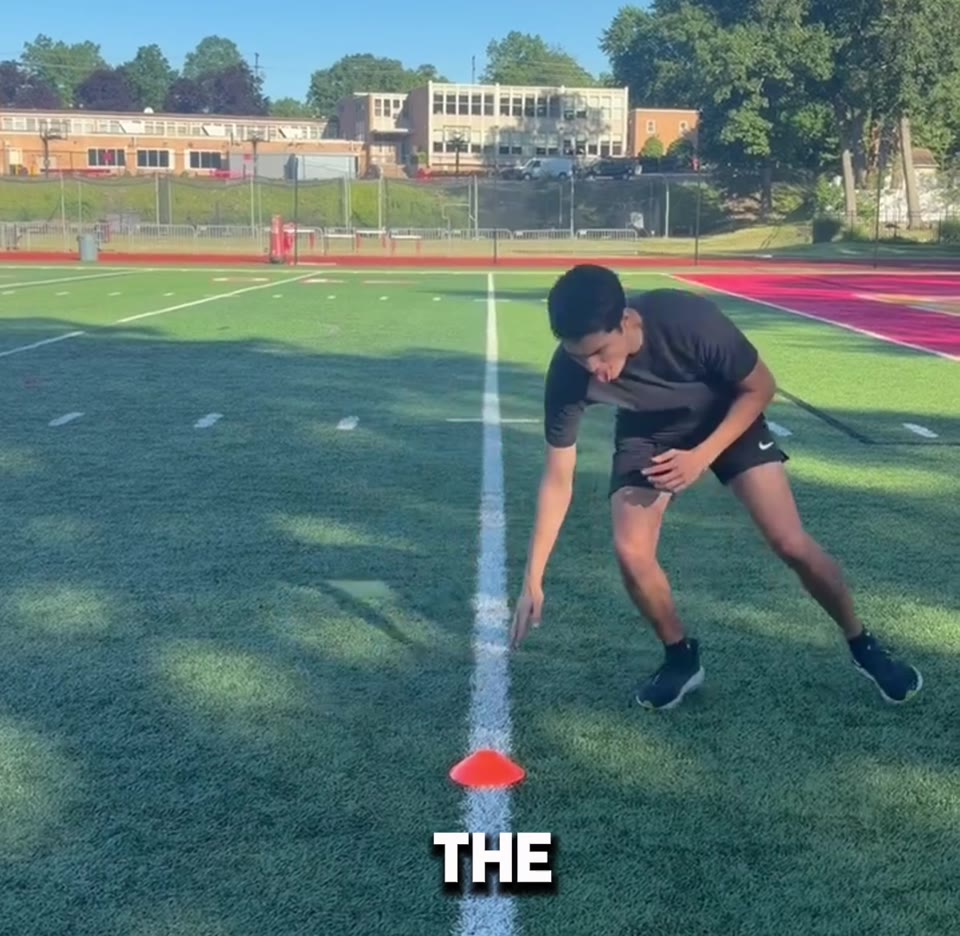
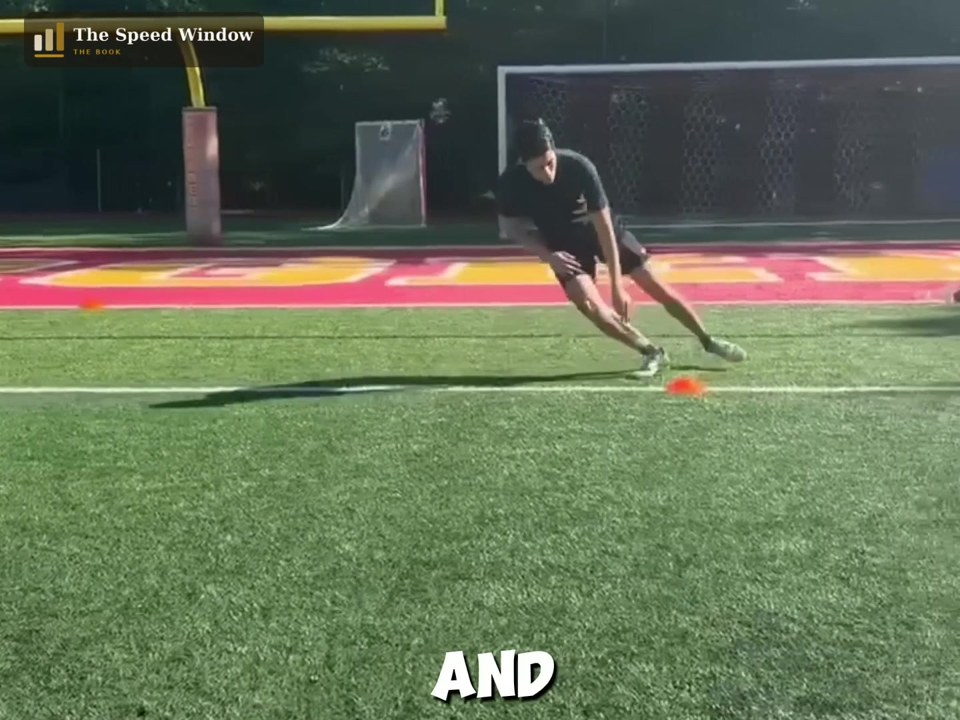
Lateral shuffle left to the left cone
True shuffle. No crossover step. Hips stay square to the front. Low center of gravity. Touch the left cone with the left hand.
Lateral shuffle right across to the right cone: 10 yards
Shuffle across the full 10-yard width. This is the longest single movement in the drill. Maintain hips-square, low posture the entire way. Touch the right cone with the right hand.
Shuffle back to center
Return to the center top cone. Touch with the left hand.
Backpedal to start: 10 yards
Do not turn and run. True backpedal: hips slightly forward, short quick steps, driving the arms forward as the feet go backward. Eyes stay forward throughout the backpedal.
Common Errors
What to watch for and how to correct it.
Crossover step during the lateral shuffle
One foot crosses in front of the other during the shuffle. This is the most common error in the T-Drill at any age. The feet must not cross. The step is always a push-and-follow: outside foot pushes, inside foot follows. Cue: 'feet never cross.'
Standing up during the cone touch
The athlete rises out of their athletic stance to reach the cone, then has to sink back down before shuffling. The center of gravity should not change during the touch. Cue: 'stay low through the touch.'
Running backward instead of backpedaling
The athlete turns and runs back to the start rather than backpedaling. The backpedal is a distinct motor pattern that must be trained specifically. Stop the rep and reset if the athlete turns.
Rushing the first sprint: arriving at the center cone out of control
The athlete sprints the first 10 yards flat-out and cannot decelerate in time to make a clean transition into the shuffle. The T-Drill is not a sprint. It is a mechanics drill. Cue: 'in control at the first cone.'
Coaching Cue
The one thing to say when you need the rep to change.
"Feet never cross. Stay low at every cone."
The two most impactful mechanics in the T-Drill are the shuffle technique and the hip height at the cones. Both errors (crossover and standing up) appear at the cone touch, which is why they share a single cue. Repeat before the first rep and after any observed error.Progressions & Regressions
Where this drill fits in the sequence.
Regress to: if the athlete is struggling
- Lateral Shuffle: isolate the shuffle pattern before integrating into the T-Drill
- Star Drill: develop multi-directional cone touch mechanics
- T-Drill slow: walk or jog pace to establish the full pattern before speed
Progress to: once the pattern is clean
- T-Drill timed. Add a stopwatch to establish a benchmark and track improvement
- T-Drill at full speed: once the pattern is clean, build toward maximal effort
Programming Notes
When and how to use this drill in a session.
Use the T-Drill as both a training drill and a periodic assessment. Run it as a training drill at 70 to 80 percent effort in the agility prep phase. Once per training block (typically every 4 to 6 weeks) run a timed version as a benchmark.
3 to 4 sets per session, each direction (start the shuffle phase going left in some sets, right in others). Full rest between sets. The T-Drill is a quality drill: half-effort reps teach half-effort mechanics.
Introduce the T-Drill in the final weeks of a Neural Window agility block, after Lateral Shuffle, Star Drill, and ladder patterns are established. It is the capstone agility drill for this window: the integration point for all earlier agility work.
Neural Window · Ages 7–12
The critical learning window.
Between ages 7 and 12, the nervous system acquires movement patterns faster than at any other stage of development. The drills trained here are not fitness drills. They are wiring sessions.
Explore the Neural WindowEvery drill here comes from the book.
The Speed Window maps all three windows: what to train, when, and why.
Get the Book