Purpose
What this drill trains, and why it matters.
The Star Drill is the Neural Window's primary multi-directional agility tool. Five cones set in a star pattern force the athlete to accelerate, decelerate, and redirect in five different directions from a single center point. No drill in this window develops the full range of directional movement skills more efficiently.
What makes the Star Drill valuable at ages 7 to 12 is not the challenge: it's the variety. The nervous system at this stage is highly adaptive and learns best when exposed to unpredictable, multi-plane demands. Each rep is a slightly different problem. That variety is the stimulus.
Execution focus must stay on deceleration quality. Young athletes can accelerate instinctively. Learning to decelerate (to absorb force, lower the hips, and redirect efficiently) requires deliberate coaching. Every touch point of the cone is a deceleration event. Coach it on every rep.
Setup
How to position your athlete before the first rep.
Set five cones in a star pattern
Place one center cone. From the center, place four outer cones at 45-degree diagonals: front-left, front-right, back-left, back-right. Each outer cone is 5 yards from center. This creates the star shape.
Athlete starts at the center cone
Athletic stance: feet hip-width, slight bend in the knees, weight on the balls of the feet, eyes up. The hands should be ready. Not behind the back.
Coach calls or points a cone
For introductory athletes, the coach calls the direction. For more experienced athletes, point or use a color-coded system. The reaction element begins even in the setup phase.
Execution
The drill, step by step.
Explode to the called cone on the go signal
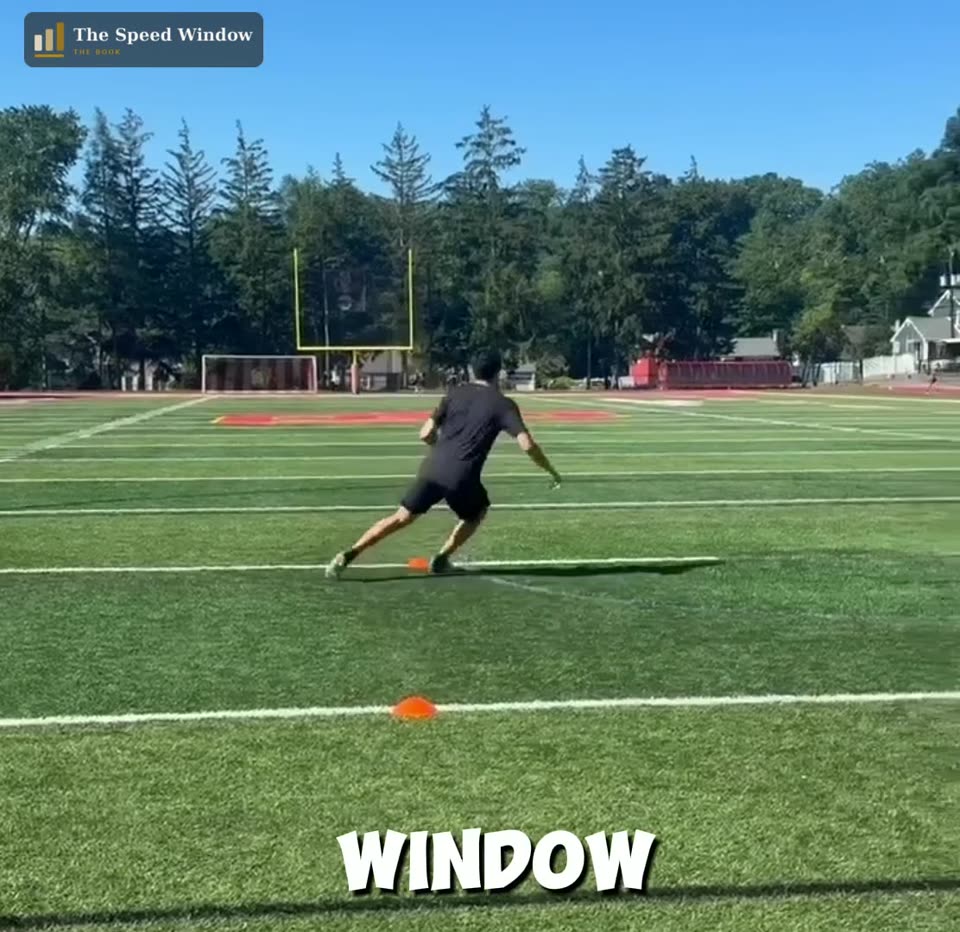
First step is a push-off from the center. Not a crossover. The hips turn in the direction of travel. Drive the arms hard on the first step.
Decelerate into the cone: touch and redirect
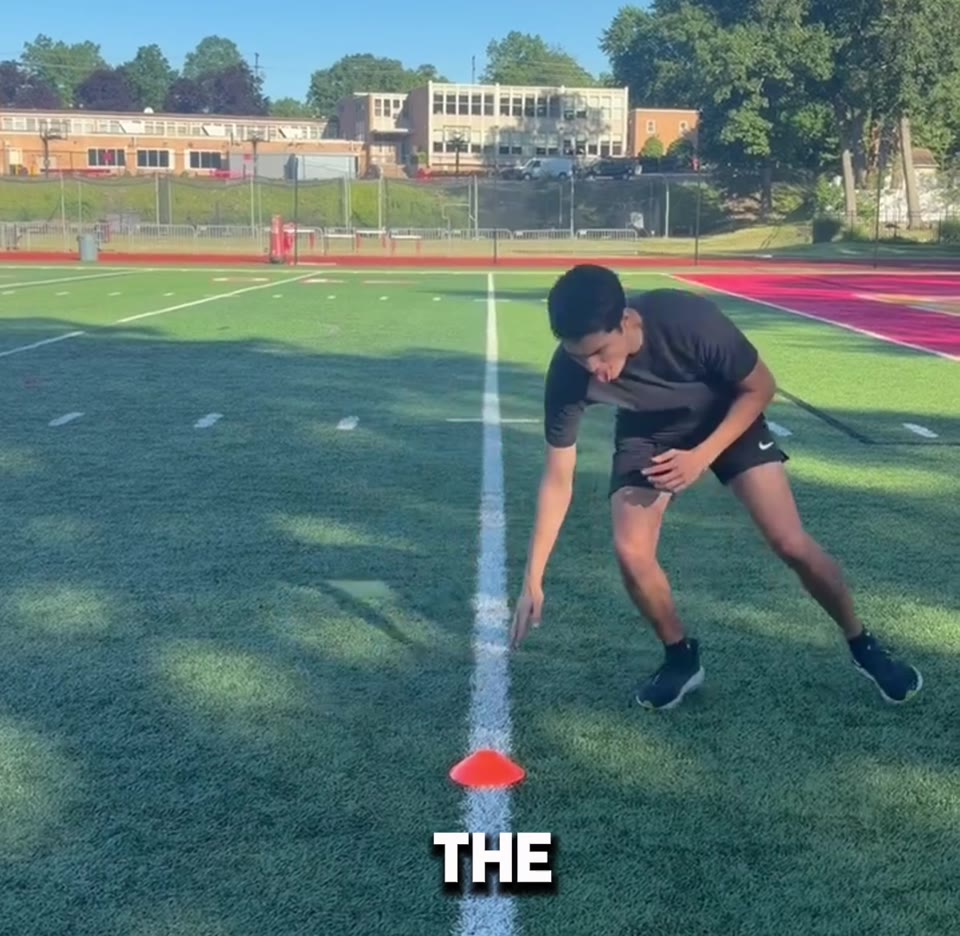
The athlete does not run through the cone. They decelerate in the last 1 to 2 yards, lower the hips, touch the cone with the outside hand, and push back toward center.
Return to center and reset
Sprint back to center, come to a full stop in the athletic stance before the next direction is called. The reset is not a rest. It is a controlled deceleration back to a ready position.
Vary the sequence across sets
Do not run the same cone order in consecutive sets. The nervous system adapts to pattern. Change the sequence so the athlete must react, not anticipate.
Common Errors
What to watch for and how to correct it.
Running past the cone. No deceleration
The athlete sprints to the cone and swings wide rather than decelerating in front of it. The cone touch is the drill. If they cannot reach back and touch, they are not decelerating early enough. Shorten to 4-yard distances until braking is established.
High center of gravity in the cut
The athlete stays upright through the redirect, losing lateral force application. Cue: 'drop your hips before you touch.' The deceleration must happen with a lowering of the center of mass.
Crossover first step
On the first step from center, the athlete crosses one foot over the other instead of pushing laterally. This wastes the first movement. Cue: 'push, don't cross.' The hip must open in the direction of travel first.
Slow reset to center
Athletes jog back to center instead of sprinting. Each return is a reactive sprint. The quality of the full rep includes the return trip.
Coaching Cue
The one thing to say when you need the rep to change.
"Low hips at the cone, explode back to center."
The two most common error points are the deceleration (hips too high) and the reset (too casual). This cue addresses both in one phrase. Say it before each rep, not after the error occurs.Progressions & Regressions
Where this drill fits in the sequence.
Regress to: if the athlete is struggling
- Lateral Shuffle: develop lateral mechanics before multi-directional patterns
- Cone Weave: lower-intensity agility with predictable direction
- T-Drill: simpler four-cone shape before the five-direction demand of the star
Progress to: once the pattern is clean
- Star Drill with reaction signal. Add a verbal or visual cue to create a reactive version
- Star Drill timed. Add a stopwatch to track directional efficiency
- Star Drill with ball: introduce a catch or dribble at each cone for sport integration
Programming Notes
When and how to use this drill in a session.
Introduce the Star Drill in weeks 4 to 6 of a Neural Window agility block, after basic lateral mechanics are established via the Lateral Shuffle and Cone Weave. Run it in the agility prep phase before any speed work.
3 to 4 sets with full recovery between each. Keep total reps low: 3 to 4 per set. This is a quality drill, not a conditioning circuit. Fatigue collapses the deceleration mechanics this drill is designed to develop.
Vary the cone order every session. The adaptive demand of the drill comes from unpredictability. Once an athlete memorizes a sequence, the reactive benefit is largely gone.
Neural Window · Ages 7–12
The critical learning window.
Between ages 7 and 12, the nervous system acquires movement patterns faster than at any other stage of development. The drills trained here are not fitness drills. They are wiring sessions.
Explore the Neural WindowEvery drill here comes from the book.
The Speed Window maps all three windows: what to train, when, and why.
Get the Book