Purpose
What this drill trains, and why it matters.
The Ickey Shuffle adds a lateral step to the Two-In foundation, creating a three-beat pattern that demands bilateral foot coordination across both sagittal and frontal planes simultaneously. In plain terms: the feet are now moving forward and sideways at the same time, which is the pattern underlying most sport actions.
This is where ladder training earns its place in the Neural Window curriculum. The Ickey Shuffle is hard enough to require real neural effort (athletes cannot run through it on autopilot) but predictable enough that technique can be coached and improved. The combination of challenge and coachability is what makes it effective at ages 7 to 12.
The three-beat rhythm (in, in, out) is also the athlete's first exposure to lateral shuffling combined with forward progress. That combined movement skill is directly transferable to defensive footwork, route running, and transition movements across virtually every team sport.
Setup
How to position your athlete before the first rep.
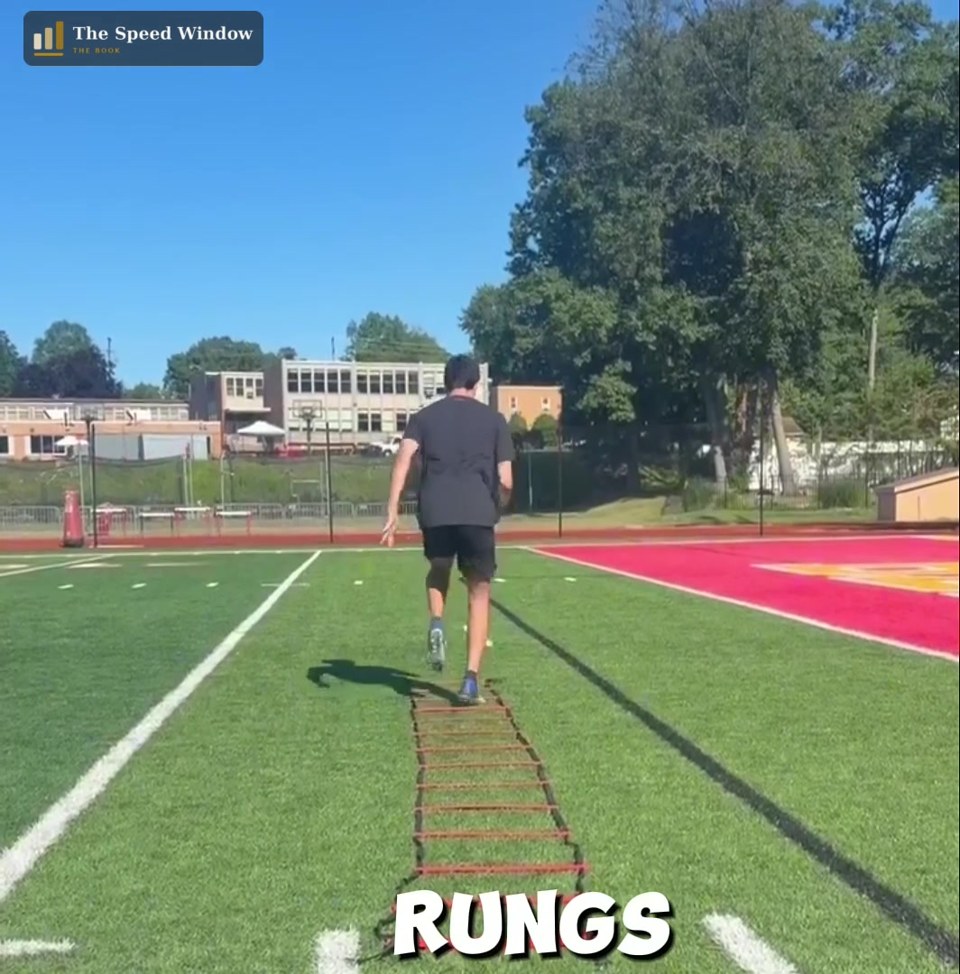
Lay the ladder flat, approach from a long side
Unlike the Two-In where the athlete runs the length, the Ickey Shuffle also requires space on the outside of the ladder for the lateral step. Ensure there is at least 2 feet of clear space on both sides of the ladder.
Identify the start side: right or left
The Ickey Shuffle steps outside to one side every rung. Begin on the left side for the first set: step out to the right. Then reverse for the next set. Run equal volume in both directions.
Walk through the pattern first: every time
The Ickey Shuffle coordination breaks down quickly at speed before it is established at slow pace. Walk through 2 full rungs at a crawl before building tempo. This is not optional for athletes new to the pattern.
Execution
The drill, step by step.
Step 1: right foot in (lead foot enters the rung)
Starting from outside the left edge of the ladder, the right foot steps into the first rung.
Step 2: left foot in (trailing foot joins inside the rung)
Left foot steps in to join the right foot, both feet now inside the same rung. This is the 'two-in' portion of the Ickey pattern.
Step 3: right foot out to the right side of the ladder
The right foot steps out to the right of the ladder: laterally, not forward. This is the 'out' beat. The athlete is now split: left foot inside the rung, right foot outside to the right.
Advance to the next rung: left foot leads into rung 2
The left foot steps forward into rung 2, right foot follows in, left steps out to the left side. The out-step alternates: right side on rung 1, left side on rung 2, and so on up the ladder.
Maintain consistent arm drive and upright posture
The lateral step is the new demand: but the arm drive and posture standards from the Two-In do not change. Arms at 90 degrees, eyes forward, ball of the foot throughout.
Common Errors
What to watch for and how to correct it.
Losing the rhythm: pattern breaks into a walk
The coordination demand overwhelms the athlete's current capacity. The solution is always to slow down before doing more reps. Rhythm established slowly transfers to speed over time. Rhythm established incorrectly at speed does not.
Heel-striking on the out-step
The lateral step lands on the heel: often because the athlete is focused on the footwork pattern and defaults to the most stable contact. Cue: 'soft landing, outside foot.' Demonstrate a light lateral step as a model.
Skipping the out-step: reverting to Two-In
The athlete omits the lateral step and simply runs the Two-In pattern. This usually happens when the coordination demand is too high at the current speed. Walk through the three-beat count: 'in, in, out' until the pattern is embedded.
Out-step going forward instead of lateral
The outside foot steps diagonally forward rather than straight to the side. The lateral out-step must be a pure sideways movement. No forward component. Cue: 'step to the side. Not forward.'
Coaching Cue
The one thing to say when you need the rep to change.
"In, in, out: same rhythm, both sides."
The verbal count 'in, in, out' is the most effective teaching tool for this drill. Use it as a rhythm guide before and during the first few passes. Once the athlete has internalized the pattern, drop the verbal count and let the movement run on its own.Progressions & Regressions
Where this drill fits in the sequence.
Regress to: if the athlete is struggling
- Ladder: Two-In: establish forward foot coordination before adding the lateral step
- Walking Ickey Shuffle. The full three-beat pattern at walking pace
- Stationary lateral step practice: stand next to the ladder and practice the out-step in isolation before integrating into the pattern
Progress to: once the pattern is clean
- Ickey Shuffle to sprint: explode out of the last rung into a 5-yard acceleration
- Ickey Shuffle timed. Add a stopwatch to measure pattern efficiency
- T-Drill: apply lateral coordination in a change-of-direction context
Programming Notes
When and how to use this drill in a session.
Introduce the Ickey Shuffle only after the Two-In is consistent and clean. This typically means at least 2 to 3 weeks of Two-In practice. Athletes who cannot run the Two-In with upright posture and even rhythm will not be able to learn the Ickey Shuffle pattern.
3 to 4 passes in each direction per session. Equal volume both ways. Do not allow a dominant direction to receive more practice. The weaker direction is where the coordination gap lives.
Pair with the Cone Weave and Lateral Shuffle in the agility prep phase. These three drills together address forward coordination (ladder), lateral mechanics (shuffle), and hip-rotation agility (weave): a complete agility warm-up for the Neural Window.

Neural Window · Ages 7–12
The critical learning window.
Between ages 7 and 12, the nervous system acquires movement patterns faster than at any other stage of development. The drills trained here are not fitness drills. They are wiring sessions.
Explore the Neural WindowEvery drill here comes from the book.
The Speed Window maps all three windows: what to train, when, and why.
Get the Book