Purpose
What this drill trains, and why it matters.
The Single-Leg RDL is the most important posterior chain exercise in the Stabilization Window, and one of the most important in the entire framework. It develops hamstring control, glute strength, and hip hinge mechanics on one leg: which is precisely how the body must function during sprinting, cutting, and landing in every sport.
During the growth period of the Stabilization Window (ages 12 to 15), the posterior chain is the region most vulnerable to injury. Rapid skeletal growth tightens the hamstrings relative to the lengthening femur. Athletes who enter this window without adequate hamstring control are at elevated risk for muscle strains, patellar tendinopathy, and lower back issues. The Single-Leg RDL addresses this vulnerability directly.
Unlike the bilateral RDL, the single-leg version also demands significant balance, hip abductor engagement, and contralateral core control. These are the same qualities required for deceleration mechanics and single-leg landing stability. The strength and the movement skill are trained in the same rep.
Setup
How to position your athlete before the first rep.
Stand on one leg, soft knee in the support leg
The standing knee is slightly bent: never locked. A soft knee maintains the muscle engagement required for balance and protects the joint.
Opposite leg stays straight and tracks behind the body
The rear leg extends straight back as the hips hinge. It acts as a counterweight and should be actively controlled. Not allowed to swing or rotate outward.
Hold a dumbbell in the opposite hand from the standing leg (contralateral)
The contralateral load challenges the core to prevent hip rotation. This is harder than the ipsilateral (same-side) hold and is the preferred grip once the pattern is stable.
Execution
The drill, step by step.
Hinge at the hip. Not a bend at the waist
The movement is a hip hinge: the torso and rear leg move together as one unit, rotating around the hip of the standing leg. The lower back should remain flat throughout. Not rounded. Think 'T-bar rotation,' not 'fold in half.'
Descend until the torso is parallel to the floor
The target is a horizontal torso (parallel to the ground) with the rear leg extended to the same height. The athlete should feel a significant stretch in the hamstring of the standing leg at this point.
Drive back to standing through the glute of the standing leg
The return movement is initiated by contracting the glute of the standing leg and driving the hips forward to standing. Do not use momentum or a back extension to return.
Hold the landing position for a moment before the next rep
On the return to standing, briefly balance on one leg before initiating the next hinge. This brief balance hold reinforces proprioception and prevents the drill from becoming a ballistic swing.
Common Errors
What to watch for and how to correct it.
Rounding the lower back
The most common and most important error. The lower back rounds at the bottom of the hinge, placing compressive force on the lumbar spine. Reduce the range of motion until the spine can stay neutral throughout. Cue: 'flat back, long spine.' Have the athlete place a dowel rod along their spine. It should maintain contact at the head, upper back, and sacrum throughout the movement.
Hip rotation: rear hip opening out
The rear hip rotates externally, opening out to the side rather than tracking straight back. This eliminates the posterior chain loading and turns the drill into a balance exercise. Cue: 'keep your back hip facing the ground.' Use a light ankle weight on the rear foot to provide proprioceptive feedback.
Not reaching horizontal: stopping too early
The athlete stops the hinge well above parallel, reducing the hamstring loading range. Progress the depth gradually. Use a target at hip height for the hand to reach toward.
Locked knee on the standing leg
A straight, locked knee on the standing leg puts all force directly into the joint rather than distributing it through the muscles. Cue: 'soft knee, always.'
Coaching Cue
The one thing to say when you need the rep to change.
"Flat back, hinge to horizontal, glute to stand."
Each word pair maps to one phase of the movement: 'flat back' sets the spine position, 'hinge to horizontal' defines the movement and the depth target, 'glute to stand' ensures the correct muscle is initiating the return. Deliver before the set, not reactively mid-rep.Progressions & Regressions
Where this drill fits in the sequence.
Regress to: if the athlete is struggling
- Assisted Single-Leg RDL: hold a wall or pole lightly with one hand to reduce the balance demand while maintaining the hinge pattern
- Romanian Deadlift (bilateral). Build the bilateral hip hinge pattern before moving to single-leg variation
Progress to: once the pattern is clean
- Single-Leg RDL with increased dumbbell load
- Single-Leg RDL to Knee Drive: stand up from the hinge and immediately drive the rear knee up to sprint mechanics position
- Trap Bar Single-Leg RDL: greater load potential with improved spinal position
Programming Notes
When and how to use this drill in a session.
Program the Single-Leg RDL 2 times per week in the Stabilization Window. Three sets of 6 to 8 reps per side with 90 seconds of rest is appropriate. The movement is technically demanding. Do not program it at the end of a session when fatigue is high.
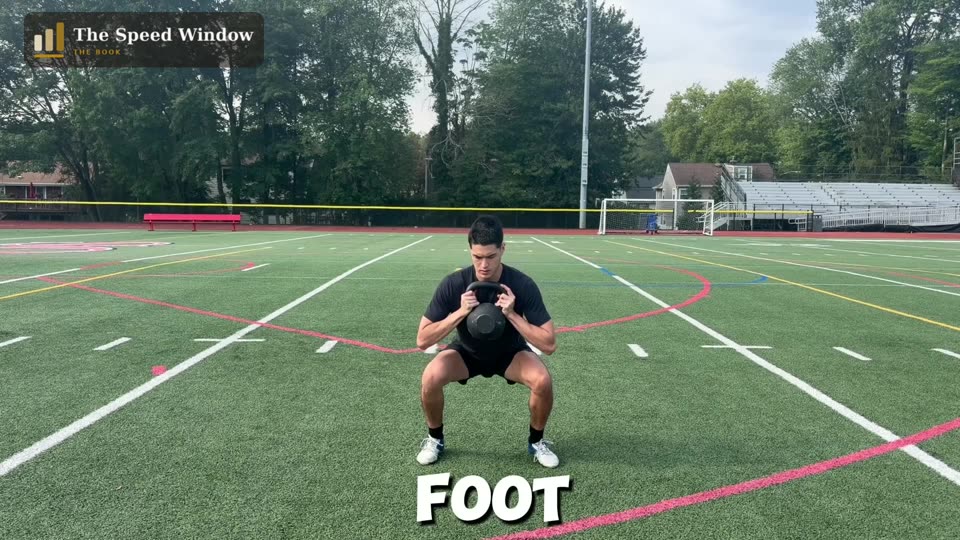
Pair the Single-Leg RDL with the Goblet Squat as a lower-body superset. This combination develops both knee-dominant and hip-dominant strength patterns in the same session, creating balanced posterior and anterior chain development.
Athletes who complete the Stabilization Window with clean Single-Leg RDL mechanics carry a significant hamstring injury resilience advantage into the Force Window, where sprint volumes and intensities increase substantially.
Stabilization Window · Ages 12–15
Re-coordination through growth.
Growth disrupts movement patterns. This window focuses on re-establishing mechanics, building foundational strength, and preparing the body for the demands of force-based training.
Explore the Stabilization WindowEvery drill here comes from the book.
The Speed Window maps all three windows: what to train, when, and why.
Get the Book