Purpose
What this drill trains, and why it matters.
The Step-Up is one of the most underestimated exercises in the Stabilization Window because it looks simple. It is not. A correctly executed step-up demands single-leg hip extension, frontal-plane knee stability, and the coordination to drive upward through one leg while the other leg adds nothing. That is a significant neuromuscular challenge for an athlete whose proprioception is being reset by growth.
The step-up belongs before the split squat in sessions where single-leg mechanics are breaking down, because it provides a higher base of support (both feet are on firm surfaces during the transition) and a clearer point of reference for hip drive. Coaches who see valgus collapse in the split squat often find the athlete can maintain alignment in the step-up, and use the step-up pattern to teach the correct hip abductor activation before returning to the split squat.
There is no spinal loading in the step-up, which makes it the preferred single-leg drill during the rapid growth phase when intervertebral disc sensitivity is highest. Drive all hip extension through the stepping leg without leaning into the box. The torso stays upright throughout.
Setup
How to position your athlete before the first rep.
Select a box height that allows 90 degrees of knee flexion
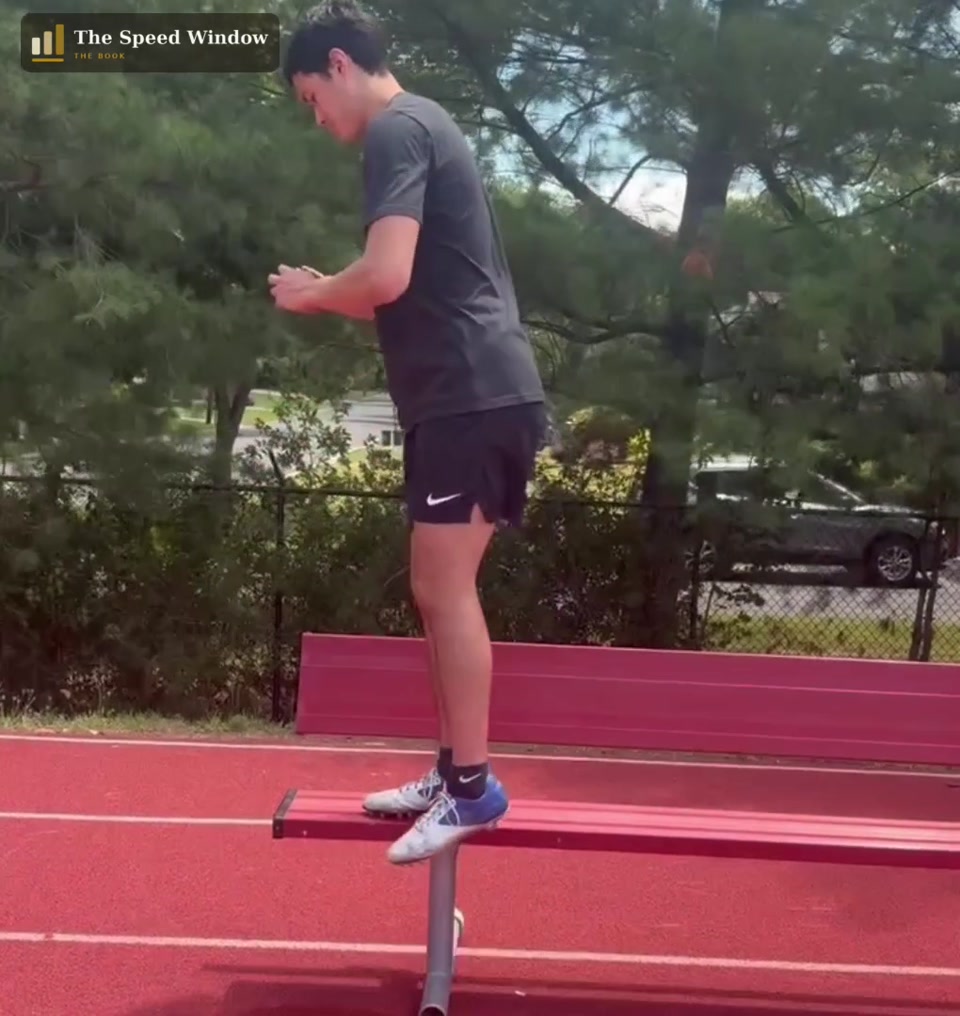
The stepping foot should be flat on the box surface and the knee bent to approximately 90 degrees before the drive begins. For most athletes ages 12-15, this is a 12- to 16-inch box. If the knee is above 90 degrees, the box is too high.
Stand facing the box, 3 to 4 inches from the front edge
Close enough that the stepping foot lands centered on the box surface. Too far back and the athlete will need to lean forward to reach the box.
Arms at sides or hands on hips
No arm swing during the step-up. The drive comes from the leg alone. Arms stay still and controlled throughout.
Execution
The drill, step by step.
Place the stepping foot fully on the box: heel in, not on the edge
The entire foot should be on the box surface. The heel must be on the box, not hanging off the edge. A partial foot contact is an unstable base.
Drive through the stepping heel: extend the hip fully at the top
Press through the heel of the stepping foot, extending the knee and hip simultaneously. At the top, the stepping leg is fully extended and the opposite leg hangs freely beside the box. Do not push off the floor leg.
The trailing leg does not push off the floor
This is the most important rule of the step-up. The floor leg stays passive. It lifts off as a result of the stepping leg's drive, not as a cooperative push. Coaches should watch for a toe-push from the floor leg on every rep.
Control the descent: step down with the non-working leg first
Lower the trailing leg to the floor with control. The stepping leg remains on the box and acts as a brake through the eccentric phase. This eccentric loading on the descent is part of the training stimulus.
Reset. Do not bounce into the next rep
Both feet return to the floor completely between reps. A brief pause, then step up again with the same leg. Do not use momentum from the descent to drive the next ascent.
Common Errors
What to watch for and how to correct it.
Pushing off the floor with the trailing leg
The floor leg provides a push-off to assist the step-up rather than staying passive. This is the most common error and effectively turns a single-leg drill into a bilateral exercise. Cue: 'only the top leg drives.' Have the athlete start with the trailing leg already lifted slightly off the floor before driving up to eliminate the assist entirely.
Leaning the torso over the box
The athlete pitches forward at the waist to get over the box rather than driving vertically. Cue: 'tall chest. Drive up, not over.' This error is often accompanied by the trailing-leg push-off. Both indicate the box height is too high or the athlete is not ready for the load.
Valgus collapse at the top
The stepping knee caves inward as the athlete reaches full extension at the top. Cue: 'push the knee out at the top.' This is the same hip abductor weakness pattern seen in the split squat. Add a resistance band around the knees for tactile feedback if the error persists.
Stepping down too fast. No eccentric control
The athlete steps down quickly or drops off the box. The descent is a controlled eccentric: slow and deliberate. Cue: 'count to two on the way down.' The descent should take at least 2 seconds.
Coaching Cue
The one thing to say when you need the rep to change.
"Top leg drives (tall chest) slow down."
'Top leg drives' prevents the floor-leg push-off. 'Tall chest' prevents the forward lean. 'Slow down' addresses the uncontrolled descent. All three in five words. Use before each set, not only after errors are observed.Progressions & Regressions
Where this drill fits in the sequence.
Regress to: if the athlete is struggling
- Split Squat: if single-leg stability is insufficient for the step-up, split squat builds the foundation
- Step-Up with wall support: one hand lightly on the wall removes the balance demand while the drive pattern is established
Progress to: once the pattern is clean
- Step-Up with dumbbells. Add light load once the bodyweight pattern is consistent and fully single-leg
- Lateral Step-Down: builds eccentric single-leg control in the frontal plane
- Single-Leg RDL: develops single-leg hinge mechanics after single-leg squat mechanics are established
Programming Notes
When and how to use this drill in a session.
Use the Step-Up as the primary single-leg strength exercise in the early weeks of the Stabilization Window, before the split squat pattern is established. Once the split squat is clean, both exercises can appear in the same session: step-up first as a warm-up for the single-leg pattern, split squat as the primary strength movement.
3 sets of 10 reps per leg. Start with the weaker leg every set. Rest 60 seconds between legs. Add load (2 × 5 lb dumbbells) only when the pattern is completely passive on the floor leg: meaning the floor foot never provides any assist on any rep.
The Step-Up is also an excellent assessment tool. A large strength or stability difference between sides will be clearly visible. Document it and track it across the training block.
Stabilization Window · Ages 12–15
Re-coordination through growth.
Growth disrupts movement patterns. This window focuses on re-establishing mechanics, building foundational strength, and preparing the body for the demands of force-based training.
Explore the Stabilization WindowEvery drill here comes from the book.
The Speed Window maps all three windows: what to train, when, and why.
Get the Book