Purpose
What this drill trains, and why it matters.
The Lateral Step-Down is the Stabilization Window's most direct training tool for frontal-plane knee control: the ability to hold the knee in alignment while absorbing force through one leg. It is also the exercise that most clearly reveals whether an athlete has the hip abductor strength and neuromuscular control to protect the knee joint during athletic movement.
The movement is simple on the surface: stand on a box, reach the non-working foot to the side and downward, touch the heel to the floor, and return. But the demand on the single standing leg (specifically on the gluteus medius and the hip abductor complex) is substantial. Athletes who have never trained this plane of control will find this exercise immediately challenging, even at bodyweight.
The lateral step-down is widely used in physical therapy for patellofemoral pain and ACL injury rehabilitation because it so directly targets the hip abductor control failure that underlies both conditions. In the Stabilization Window, it serves as the preventive version of that same intervention: building the control before the athletic demands of the Force Window expose its absence.
Setup
How to position your athlete before the first rep.
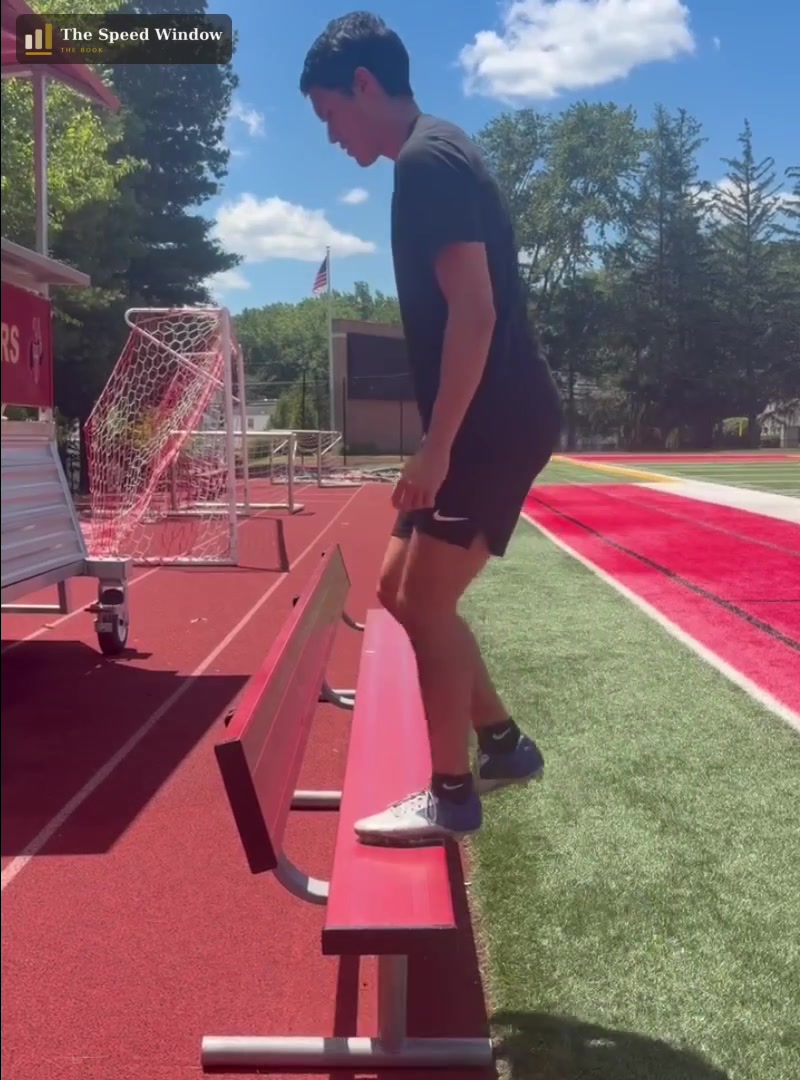
Stand sideways on the box: working leg on the box, stepping leg hanging off the side
The standing foot is parallel to the box edge, approximately 2 to 3 inches from the side of the box. The non-working leg hangs freely off the side of the box before the rep begins.
Box height: 6 to 8 inches to start
A lower box reduces the range of motion and makes the stability demand more manageable while the pattern is being learned. Progress to 10 to 12 inches once control is consistent.
Arms can be extended forward for balance
Arms out in front of the body at shoulder height is acceptable during learning. As control improves, bring the arms to the sides to increase the stability demand.
Execution
The drill, step by step.
Initiate the movement by bending the standing knee and reaching the free foot to the side
The descent is driven by a controlled bend at the standing knee and hip: a single-leg squat with a lateral reach. The free foot reaches out to the side of the box and downward, toward the floor.
Maintain the standing knee over the second toe. Do not let it cave in
As the standing knee bends, it must track over the second toe. This requires active hip abductor engagement throughout the descent. Do not allow the knee to drift inward under any circumstances.
Lightly touch the heel to the floor. No weight transfer
The stepping heel touches the floor with no more weight than a feather. The moment full weight transfers to the floor foot, the standing leg loses its training stimulus. Touch and return.
Drive back up through the standing heel: control the ascent
Press through the heel of the standing leg and extend back to the starting position. The ascent should be as controlled as the descent. No bouncing, no momentum from the floor foot.
Common Errors
What to watch for and how to correct it.
Knee caving inward on descent. The primary error
The standing knee collapses toward the midline as the athlete descends. This is the movement pattern that contributes to ACL and patellofemoral injury. Stop immediately. Reduce the box height, or regress to the Step-Up until hip abductor strength improves. Cue: 'push the standing knee out, track it over the second toe.'
Full weight transfer to the floor foot
The athlete steps down with full weight onto the reaching foot, converting the drill to a bilateral exercise. The floor touch is a reference point. Not a step. Cue: 'touch and come right back. No weight on that foot.'
Rapid, uncontrolled descent
The athlete drops quickly toward the floor rather than lowering with control. The eccentric control during the descent is the training stimulus. Cue: 'four counts down, one count up.' Time the descent explicitly.
Trunk tilting laterally toward the stepping leg
The torso leans toward the reaching foot as it descends. This Trendelenburg pattern indicates gluteus medius weakness on the standing side. Cue: 'keep the shoulders level, hips level.' This error will resolve over weeks of consistent lateral step-down training as the gluteus medius strengthens.
Coaching Cue
The one thing to say when you need the rep to change.
"Knee out, touch and return, stay level."
'Knee out' prevents valgus collapse. 'Touch and return' prevents weight transfer. 'Stay level' prevents the trunk tilt. This three-part cue targets the three most diagnostically significant errors in the lateral step-down. Use it as a pre-set checklist, not as a correction.Progressions & Regressions
Where this drill fits in the sequence.
Regress to: if the athlete is struggling
- Step-Up: develop basic single-leg drive mechanics before the eccentric frontal-plane demand
- Single-leg balance hold on the box: stand on the box on one leg for 10 seconds to establish postural control before adding the step-down range
Progress to: once the pattern is clean
- Lateral Step-Down with increased box height (10–12 inches)
- Lateral Step-Down with added load: dumbbell in the opposite hand to increase the anti-lateral-flexion demand
- Single-Leg Squat: rear-foot-elevated Bulgarian (Force Window)
Programming Notes
When and how to use this drill in a session.
Place the Lateral Step-Down after the Step-Up and Split Squat in the re-coordination section of Stabilization Window sessions. It is the most neurologically demanding of the three single-leg exercises and should come when the pattern is primed but before fatigue degrades the quality.
3 sets of 8 reps per leg. Start with the weaker side. Rest 60 to 90 seconds between sides. A 4-count descent and 1-count ascent is the recommended tempo for the first training block. Progress to a 3-count descent once the pattern is stable.
Track knee alignment visually on every rep. The lateral step-down is both a training exercise and a screening tool. Persistent valgus collapse on one side despite consistent training is a flag that warrants a closer assessment of that athlete's hip abductor strength and ankle mechanics.
Stabilization Window · Ages 12–15
Re-coordination through growth.
Growth disrupts movement patterns. This window focuses on re-establishing mechanics, building foundational strength, and preparing the body for the demands of force-based training.
Explore the Stabilization WindowEvery drill here comes from the book.
The Speed Window maps all three windows: what to train, when, and why.
Get the Book