Purpose
What this drill trains, and why it matters.
The Depth Jump is the Force Window's primary reactive strength exercise. Where the Broad Jump trains the ability to produce force from a static loading position, the Depth Jump trains the ability to absorb and immediately redirect force. The stretch-shortening cycle at its highest demand. This quality is essential for sport: every cut, every deceleration-acceleration sequence, every reactive jump involves this rapid eccentric-to-concentric transition.
The depth jump works by pre-loading the muscles with an eccentric stress (the drop) and immediately demanding a maximal concentric response (the jump). The faster the athlete can transition from landing to takeoff, the more elastic energy is captured and returned. This is not the same as a box jump. The depth jump is a reactive drill. The goal is minimal ground contact time.
This drill has the highest plyometric training demand in the Force Window. Do not introduce it before the athlete can single-leg squat to 90 degrees with control, decelerate cleanly from a sprint, and demonstrate stable bilateral landing mechanics. The reactive demand is significant and the injury risk for unprepared athletes is real.
Setup
How to position your athlete before the first rep.
Select box height based on the athlete
Start with a 12-inch box for athletes new to depth jumps. Progress to 18 and 24 inches only after reactive speed on the lower boxes is well-established. Higher boxes are not better. They increase eccentric load without necessarily improving reactive quality.
Mark the landing zone: 18 to 24 inches in front of the box
The athlete drops off the box and lands within a marked 18-to-24-inch zone in front of the box. This keeps the landing controllable and the takeoff consistent.
Position a second marker for the jump target
Mark a line or cone 2 to 3 feet in front of the landing zone as the horizontal jump target. This gives the athlete a physical target and drives the forward-direction effort.
Execution
The drill, step by step.
Step off the box. Do not jump off
The athlete steps off the edge of the box rather than jumping. Jumping off increases eccentric velocity beyond what can be trained effectively. Step, do not jump.
Land on the balls of both feet simultaneously
The athlete makes contact with the balls of both feet at the same time. Not heel first. The heel barely touches the ground during the transition. Landing flat-footed or heel-first destroys the reactive component.
Minimize ground contact: immediately jump
The athlete's goal is to spend as little time on the ground as possible before jumping. Think of the ground as hot. The transition from landing to takeoff should be explosive and immediate. Not a pause, not a squat.
Drive the arms and jump forward and up
The arm swing drives the jump. The direction is forward and up. Not straight vertical. The athlete aims for the marked target in front of the landing zone.
Stick the landing of the final jump
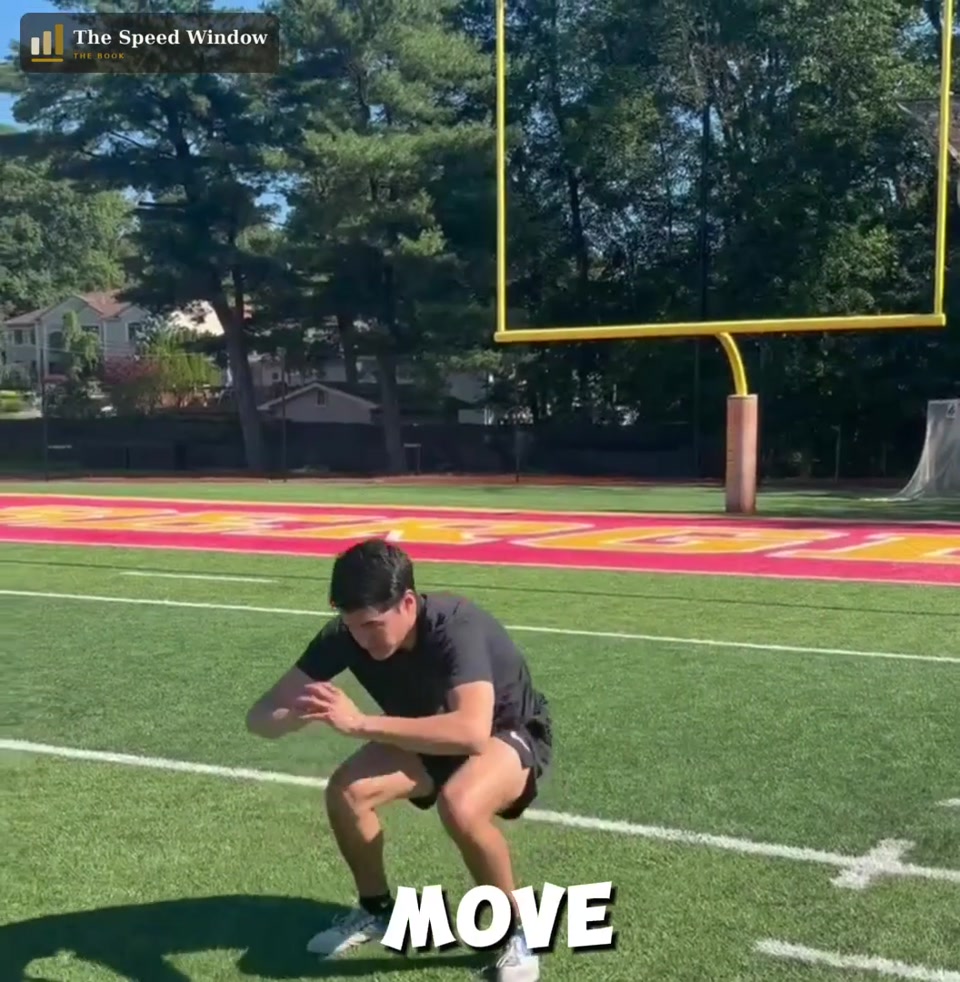
The jump lands in a quarter-squat position, controlled and stable. Do not allow the athlete to land and crumble. The landing mechanics matter as much as the takeoff.
Common Errors
What to watch for and how to correct it.
Landing flat-footed or heel-first
The heel hits the ground before the ball of the foot, eliminating the elastic energy storage in the calf-Achilles complex. This is the most common error and the most damaging to drill effectiveness. Cue: 'land on the balls. No flat feet.'
Pausing on the ground before jumping
The athlete lands, pauses, then jumps. This is a squat jump following a drop, not a depth jump. The reactive element is completely lost. Cue: 'the ground is hot, bounce immediately.'
Jumping off the box instead of stepping
The athlete adds momentum by jumping off the box. This exceeds the safe eccentric demand. Instruct: 'step off, one foot, then the other.'
Coaching Cue
The one thing to say when you need the rep to change.
"Land on the balls (the ground is hot) drive forward."
Three cues for three phases: the landing position (balls of the feet), the ground contact time (hot ground = get off it), and the jump direction (forward, not up). Deliver all three before the first rep. The 'hot ground' cue is vivid and children and young athletes remember it immediately.Progressions & Regressions
Where this drill fits in the sequence.
Regress to: if the athlete is struggling
- Box Jump (Step Down) builds landing quality without the reactive demand
- Pogo Hops (Neural): rapid bilateral ankle bouncing develops the tendon stiffness that depth jumps require
- Drop Landing: step off the box and absorb with no jump, focus entirely on landing mechanics
Progress to: once the pattern is clean
- Depth Jump to Box: jump onto a raised platform rather than forward, increasing vertical demand
- Depth Jump + Sprint: immediately sprint 10 yards after the jump to train reactive-to-sprint transfer
- Repeated Depth Jumps: three consecutive depth jumps with minimal ground contact each time
Programming Notes
When and how to use this drill in a session.
Program the Depth Jump two times per week maximum. Four sets of four to six reps is the standard prescription. Rest fully between sets: two to three minutes minimum. Fatigue completely changes the nature of reactive training.
The depth jump has a high central nervous system demand. Do not program it after heavy strength work or at the end of a fatigued training session. It belongs in the first portion of training, after a thorough warm-up but before any high-fatigue work.
Increase box height by 6-inch increments only when the athlete's ground contact time decreases. Not when they simply complete the reps successfully. Speed of the reactive transition is the performance measure, not the height of the jump.



Force Window · Ages 15–18
Power on a proven foundation.
The athlete is physically ready for high-intensity training. Speed-power, strength, and explosive work are built on what the first two windows established.
Explore the Force WindowEvery drill here comes from the book.
The Speed Window maps all three windows: what to train, when, and why.
Get the Book