Purpose
What this drill trains, and why it matters.
The Broad Jump is the Force Window's primary lower-body power assessment and one of its most effective training tools. Unlike the Trap Bar Deadlift (which measures maximal strength) or the Power Clean (which develops rate of force development) the Broad Jump measures what those qualities produce: horizontal power output. The distance an athlete can broad jump correlates strongly with sprint acceleration. It is both a diagnostic and a training stimulus.
At the Force Window level, this is not the controlled landing exercise of the Neural Window. This is a max-effort jump with the intent to move as far as possible. The athlete loads aggressively, drives the arms, and produces maximum force in the horizontal direction. The landing must be athletic, but the primary goal is horizontal displacement.
Use this drill as both a training exercise and a progress measure. Testing the Broad Jump every four to six weeks gives the coach a clean window into whether the Force Window program is producing the power output it should.
Setup
How to position your athlete before the first rep.
Mark the start line and measure from take-off
Use athletic tape or a line on the floor. Measurement is taken from the takeoff line to the nearest point of the landing: typically the heel of the back foot if the athlete stumbles forward, or the back of the foot upon landing.
Start in a powerful athletic stance
Feet hip-width, slight knee bend, weight forward on the balls of the feet. The athlete is not standing upright. They are already preparing the loading position before the countermovement begins.
Coach measures and provides immediate feedback
Distance feedback after each attempt drives effort. Athletes jump further when they know how far they jumped on the previous attempt. Track every measurement and show the athlete their progress within the session.
Execution
The drill, step by step.
Load aggressively: deep hip hinge with arm swing back
The athlete drops into a deep hip hinge, swinging both arms behind the body simultaneously. The loading position should look like the bottom of an aggressive swing: hips back, knees bent, chest forward, arms behind.
Drive forward and up: arms lead the jump
From the loaded position, the athlete explodes forward, driving the arms aggressively upward and forward to add momentum. The jump is angled forward. Not straight up.
Reach forward in the air: maximize flight time
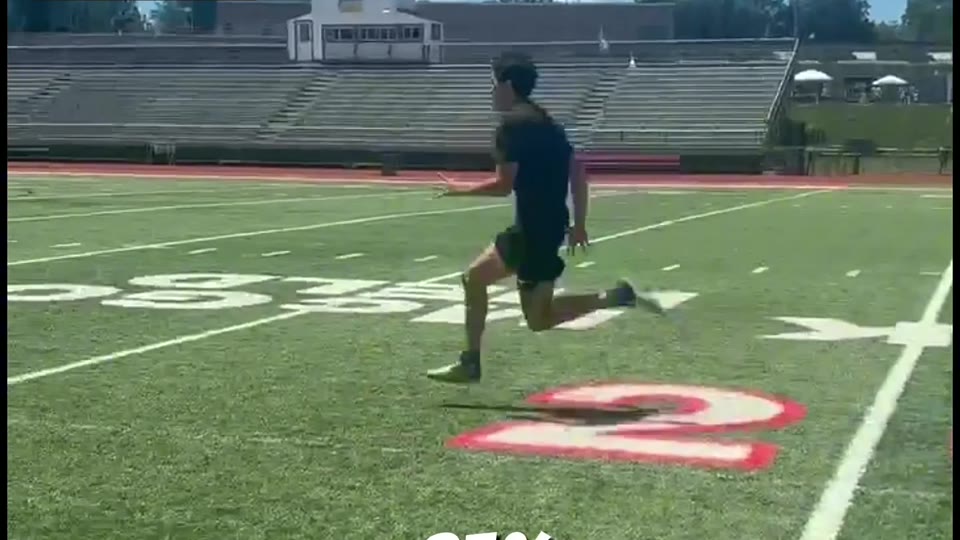
During flight, the athlete pulls the knees toward the chest and reaches the arms forward. This shifts the center of mass forward and increases horizontal distance.
Land athletically: absorb through the hips and knees
The athlete lands on both feet simultaneously, absorbing the impact through a hip and knee bend. The landing must be stable. No stumbling forward, no hands touching the ground. A wobbling or unstable landing indicates the athlete cannot yet decelerate the power they are producing.
Common Errors
What to watch for and how to correct it.
Jumping straight up: insufficient horizontal angle
The athlete jumps at too steep an angle, prioritizing height over horizontal distance. The takeoff angle for maximum horizontal distance is approximately 45 degrees, but most athletes should lean further forward given the countermovement. Cue: 'drive forward, not up.'
Arm swing too small: under-loading the countermovement
The arm swing is abbreviated and does not contribute meaningful momentum to the jump. The arm swing in a max-effort broad jump is aggressive and full-range. Cue: 'swing the arms like you mean it. They add distance.'
Landing too upright: stumbling forward
The athlete lands with the hips too high and immediately stumbles forward. This indicates insufficient forward lean in the landing mechanics. The athlete should land in a quarter-squat with the chest over the knees.
Coaching Cue
The one thing to say when you need the rep to change.
"Load deep, drive forward: stick the landing."
Each component of this cue maps to a different phase of the jump: 'load deep' addresses the countermovement quality, 'drive forward' corrects the vertical jump error, 'stick the landing' makes deceleration quality explicit. The cue works as a pre-jump checklist.Progressions & Regressions
Where this drill fits in the sequence.
Regress to: if the athlete is struggling
- Box Jump (Step Down (Neural/Stabilization)) develops landing mechanics at lower power demand
- Broad Jump + Stick (Neural): controlled version with full landing focus
- Countermovement Jump: vertical version to build the arm swing pattern
Progress to: once the pattern is clean
- Triple Broad Jump: three consecutive max-effort jumps, develops the ability to reapply force rapidly
- Bounding: alternating single-leg horizontal jumps, increases the power demand per leg
- Broad Jump + Sprint: immediately sprint 10 yards after landing, trains power-to-speed transfer
Programming Notes
When and how to use this drill in a session.
Program the Broad Jump as a power development tool two times per week in the early Force Window, transitioning to a once-weekly testing/maintenance role once the athlete's max distance plateaus.
Six max-effort attempts with full recovery between each is the correct training stimulus. Do not do fifteen broad jumps. This is not a conditioning exercise. It is a maximal power exercise, and power requires full neural recovery between attempts.
Track the best of six attempts in every session. Athletes should see consistent improvement over the first six to eight weeks of Force Window training. Plateauing distance is a signal to review strength foundation before increasing jump training volume.
Force Window · Ages 15–18
Power on a proven foundation.
The athlete is physically ready for high-intensity training. Speed-power, strength, and explosive work are built on what the first two windows established.
Explore the Force WindowEvery drill here comes from the book.
The Speed Window maps all three windows: what to train, when, and why.
Get the Book