Purpose
What this drill trains, and why it matters.
The Plyometric Box Jump at the Force Window level is not the introductory landing drill of the Neural or Stabilization Window. It is a max-height effort. The athlete's goal is to reach as high as possible on the box, driving both the arm swing and the hip extension to their maximum output. The box is a vertical power assessment tool as much as it is a training exercise.
Vertical jump height correlates with fast-twitch muscle fiber recruitment and with the rate of force development that powers sport performance. Increasing an athlete's plyometric box jump height over a Force Window training cycle is a meaningful measure of explosive power development. Track it like you track the deadlift.
At this stage, landing mechanics should already be established. The Neural Window's Box Jump. Step Down built the deceleration pattern. The Stabilization Window reinforced it. The Force Window's box jump can now be a full-effort explosive exercise because the athlete knows how to land. Do not skip the foundation and jump to this drill. The landing quality at max effort is only safe because of what was trained before.
Setup
How to position your athlete before the first rep.
Select box height at or near current max
The Force Window box jump should challenge the athlete. Select a box height that requires a significant effort. Not a box so high that form breaks down, but high enough that success requires full commitment on every rep.
Stand 12 to 18 inches in front of the box
The starting position is close enough to the box that the athlete can step forward into the jump without a running approach, but far enough that the landing is centered on the box, not on the edge.
Ensure the box is stable and non-slip
The box must be stable under the landing load. For plyometric boxes, check that the surface has grip. Foam plyo boxes are preferred over wooden boxes for max-effort jumping.
Execution
The drill, step by step.
Load aggressively: deep countermovement with full arm swing
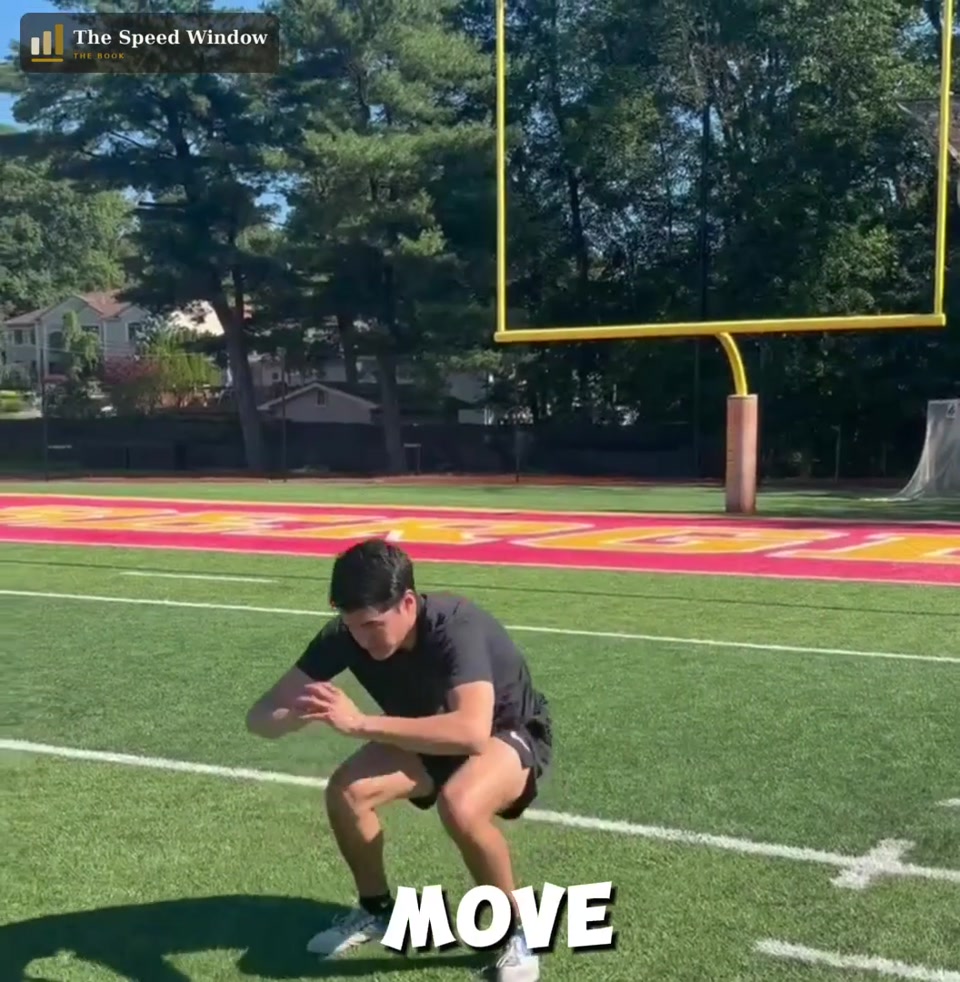
The athlete drops into a quarter-to-half squat, driving both arms behind the body simultaneously. The countermovement is aggressive. Not a small dip, but a loaded hinge that creates significant stretch-reflex tension.
Explode upward. Drive the arms and extend fully
From the bottom of the countermovement, the athlete drives both arms upward and extends the ankles, knees, and hips fully at takeoff. The goal is maximum height: full triple extension is required.
Pull the knees up in flight
In the air, the athlete pulls the knees toward the chest to clear the box and land in the center rather than the front edge. Do not confuse this with jumping with a tucked position from the start. The extension is first, the tuck is in flight.
Land softly: absorb through the hips and knees
The landing is a controlled absorption. The knees and hips flex to decelerate the impact. The landing position is a quarter squat with the chest tall. Do not allow the knees to cave inward on the landing.
Step down. Do not jump down
The athlete steps down from the box one foot at a time. Jumping down converts the drill into a depth jump and adds eccentric demand beyond what is being trained. Step down, reset, and jump again.
Common Errors
What to watch for and how to correct it.
Insufficient countermovement: jumping from a flat position
The athlete does not load the hips sufficiently and jumps from near vertical. This reduces the contribution of the stretch-reflex and limits jump height. Cue: 'load the hips, sit into it before you jump.'
Landing on the edge of the box
The athlete under-jumps and lands on the front edge of the box rather than the center. This is a fall risk. Reduce the box height until the athlete can consistently land centered.
Knees caving on the landing
The knees collapse inward on the landing, placing valgus stress on the knee joint. Cue: 'knees out, land strong.' This is a hip abductor weakness issue as much as a mechanics issue.
Coaching Cue
The one thing to say when you need the rep to change.
"Load deep (drive through) land strong."
Three-phase cue for the three critical moments: the countermovement (load deep), the takeoff (drive through (meaning full extension), and the landing (land strong) meaning controlled and stable). This cue works for virtually every box jump error an athlete will make.Progressions & Regressions
Where this drill fits in the sequence.
Regress to: if the athlete is struggling
- Box Jump (Step Down (Neural)) controlled jump onto lower box with explicit step-down
- Broad Jump — Max Effort: horizontal version of the max-effort principle if vertical jump is technically limiting
- Countermovement Jump: same movement pattern without the box, removes the landing-on-edge risk
Progress to: once the pattern is clean
- Depth Jump: adds pre-loading from a drop, increasing reactive demand
- Box Jump Variations: single-leg box jump, lateral box jump, rotational box jump for sport-specific directions
- Box Jump to Back-to-Back Broad Jump: plyometric complex training
Programming Notes
When and how to use this drill in a session.
Program the Plyometric Box Jump twice per week in the Force Window, typically in the same session as the Broad Jump. One trains vertical power, the other horizontal. Same engine, two directions.
Four sets of four to six reps. Start each set fresh. If jump height drops significantly from rep to rep within a set, the set is over. Fatigued box jumps train conditioning, not power.
Test max box height every four weeks. Provide a box the athlete has not attempted before. Record the height at which they succeed and the height at which they fail. This is your best single measure of lower-body explosive power development in the Force Window.
Force Window · Ages 15–18
Power on a proven foundation.
The athlete is physically ready for high-intensity training. Speed-power, strength, and explosive work are built on what the first two windows established.
Explore the Force WindowEvery drill here comes from the book.
The Speed Window maps all three windows: what to train, when, and why.
Get the Book