Purpose
What this drill trains, and why it matters.
The Box Drill is the Stabilization Window's most complete multi-directional agility exercise because it demands all four movement planes (forward sprint, lateral shuffle, backpedal, and lateral shuffle) in a single continuous pattern. Where the T-Drill emphasizes deceleration and cut mechanics at the cone, the Box Drill emphasizes sustained multi-directional movement quality across a continuous loop.
The Box Drill also develops spatial awareness in all planes simultaneously, which is directly relevant to the defensive positioning and offensive route-running demands of most team sports. An athlete who can move fluidly in all four directions at controlled speed is developing the movement vocabulary that sport-specific training will later channel into sport-specific patterns.
The key distinction from the T-Drill is that the Box Drill has no stop-and-cut moments. The corners require a smooth direction change without a pronounced deceleration and plant. This smooth direction change is a different skill than the T-Drill plant-and-push, and both are necessary. Use both drills in the Stabilization Window agility curriculum rather than choosing one.
Setup
How to position your athlete before the first rep.
Set four cones in a square: 5 yards on each side
A perfect square: 5 yards between each adjacent cone. Label the corners 1 (start), 2 (forward right), 3 (forward left from start side), 4 (return start). The square should be exactly 5 yards on each side.
Establish a consistent starting corner and a consistent direction
The athlete always starts at cone 1. Run clockwise in some sets, counterclockwise in others. Equal volume in both rotation directions across the session.
Walk through the full pattern once before speed
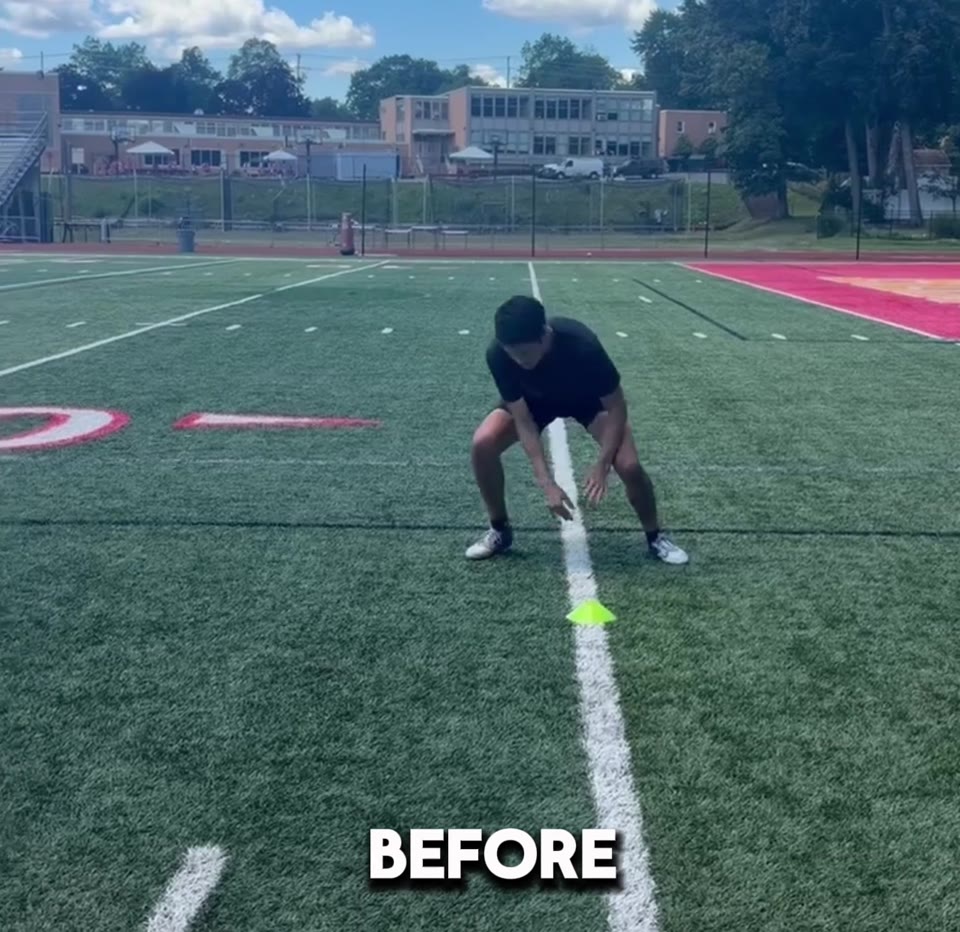
Walk the four corners: forward sprint to cone 2, lateral shuffle to cone 3, backpedal to cone 4, lateral shuffle back to cone 1. The pattern must be automatic before any speed is added.
Execution
The drill, step by step.
Sprint forward to cone 2: 5 yards
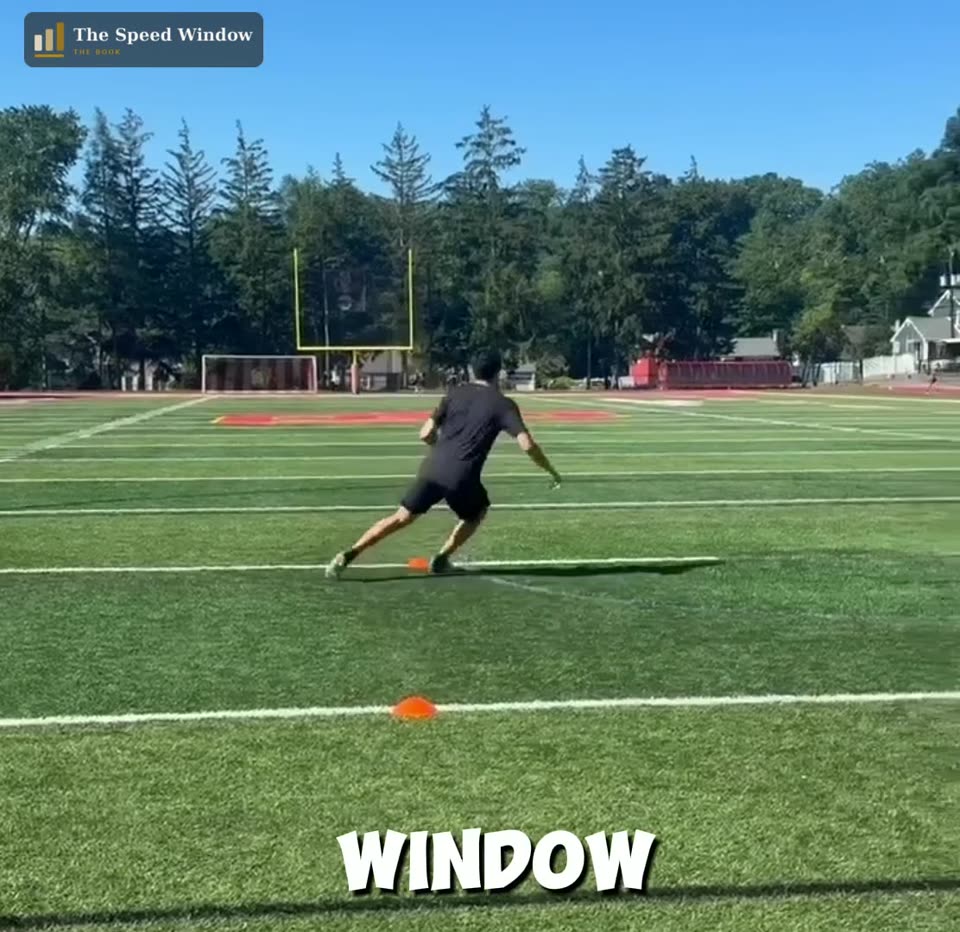
Full sprint effort. At cone 2, the body transitions smoothly into a lateral shuffle: there is no stop. The direction change at the corner is fluid, not a plant-and-push.
Lateral shuffle across to cone 3: 5 yards
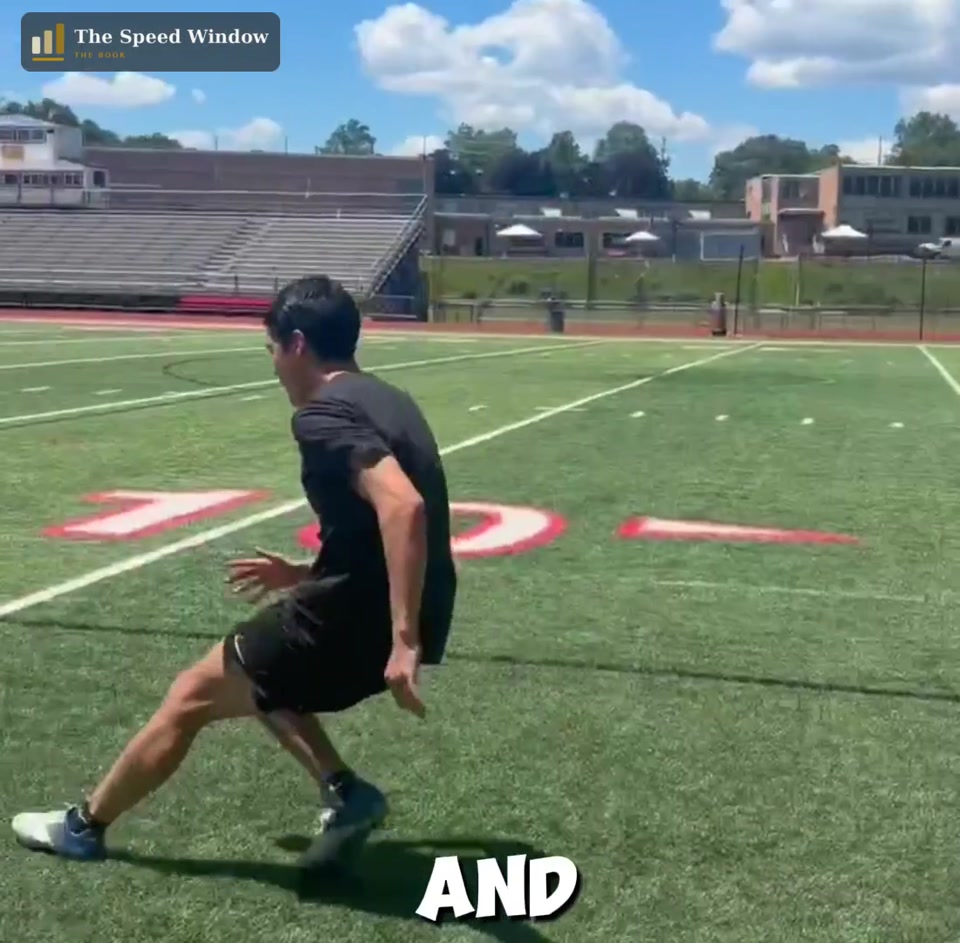
True shuffle: feet do not cross. Hips stay square to the original facing direction. Low center of gravity maintained through the full 5-yard shuffle. At cone 3, transition smoothly into the backpedal.
Backpedal to cone 4: 5 yards
True backpedal. No turning, face stays forward, short quick steps. At cone 4, transition smoothly into the lateral shuffle back to the start.
Lateral shuffle back to cone 1: 5 yards, then sprint through
Shuffle back to the start cone and sprint through it: 3 to 5 yards past cone 1. Do not decelerate at the start cone.
The corners are smooth transitions. Not stops
The defining characteristic of the Box Drill over the T-Drill is the continuous flow through the corners. The athlete never fully stops. They change direction on the move. This requires anticipatory deceleration and earlier body preparation for the next direction.
Common Errors
What to watch for and how to correct it.
Stopping at each corner instead of flowing through
The athlete comes to a near-stop before changing direction at each corner, converting the Box Drill into four separate sprints. Cue: 'flow through the corners. No stopping.' Reduce speed until the direction changes can be made without stopping.
Shuffle crossover at the lateral sections
The feet cross during the shuffle corners. The same no-crossover rule applies. Cue: 'feet never cross in the shuffle. Push and follow.'
Turning to run backward instead of backpedaling
The athlete turns and runs rather than backpedaling on the rear section. Cue: 'face stays forward, true backpedal.' If the athlete consistently turns on the backpedal, address it with isolated backpedal practice before the full Box Drill.
Losing the pattern under speed: skipping a corner
The athlete rushes through the drill and misses or shortchanges a corner. The pattern is the drill. A fast, incomplete Box Drill is a worse training stimulus than a slow, complete one. Reduce speed.
Coaching Cue
The one thing to say when you need the rep to change.
"Flow through the corners, feet never cross, face forward on the back."
Each of the three most common errors gets its own cue element: the stopping at corners (flow through), the shuffle crossover (feet never cross), and the turn-and-run on the backpedal section (face forward on the back). All three cues are necessary because all three errors appear in the same drill.Progressions & Regressions
Where this drill fits in the sequence.
Regress to: if the athlete is struggling
- T-Drill: develops the stop-and-cut mechanics before the flowing Box Drill direction changes
- Pro Agility — Technical: simpler two-direction pattern before the four-direction Box Drill
- Lateral Shuffle: isolate the shuffle mechanics in each direction before combining them in the Box Drill
Progress to: once the pattern is clean
- Box Drill at higher speed: 85 to 90 percent effort once the pattern is clean at 75 percent
- Box Drill timed. Add a stopwatch to establish a benchmark
- Pro Agility — Max Effort (Force Window): maximal speed change of direction after the Box Drill mechanics are established
Programming Notes
When and how to use this drill in a session.
Use the Box Drill as the capstone agility exercise of the Stabilization Window: the final agility drill in sessions that contain Pro Agility — Technical and Deceleration Drill — 5-3-1. These three drills together constitute a complete agility session: deceleration mechanics (5-3-1), cut mechanics (Pro Agility), and multi-directional flow (Box Drill).
3 to 4 sets in each rotation direction. Full recovery between sets. The pattern must be walked through at the beginning of every session: even experienced athletes benefit from the slow walkthrough to reinforce the corner transitions before speed is added.
Track the pattern quality over the training block. An athlete who is consistently clean in one rotation direction but struggles in the other has a directional agility asymmetry. Give the weaker direction more volume across the final weeks of the block.
Stabilization Window · Ages 12–15
Re-coordination through growth.
Growth disrupts movement patterns. This window focuses on re-establishing mechanics, building foundational strength, and preparing the body for the demands of force-based training.
Explore the Stabilization WindowEvery drill here comes from the book.
The Speed Window maps all three windows: what to train, when, and why.
Get the Book