Purpose
What this drill trains, and why it matters.
The Pro Agility — Technical is the 5-10-5 shuttle run at 75 percent effort with a deliberate focus on cut mechanics rather than time. The Force Window version of this drill is about speed. The Stabilization Window version is about how you move: the hip position at the cut, the braking mechanics before the direction change, and the push-off mechanics out of the cut.
The reason the Pro Agility belongs in the Stabilization Window at reduced intensity is that the cut mechanics for a multi-directional change-of-direction drill are complex enough to require dedicated technical work before speed is added. Athletes who run the Pro Agility at full speed without technical preparation lock in whatever compensations they currently have (high hips at the cut, crossover steps, knee valgus in the plant) into an increasingly fast and ingrained pattern.
Technical Pro Agility is also where the coach gets the clearest view of the athlete's bilateral agility mechanics. Most athletes cut faster in one direction than the other, and the discrepancy is more visible at 75 percent effort than at maximal speed. Identify the weaker side and give it more volume across the training block.
Setup
How to position your athlete before the first rep.
Set three cones in a line, 5 yards apart
Total span of 10 yards. The athlete starts at the center cone. The two outer cones are 5 yards to the left and right of the start.
The athlete chooses a starting direction
The athlete begins by sprinting to one outer cone first (let's say right), then cuts across to the far outer cone (10 yards), then sprints back through the center. Alternate which direction goes first across sets.
No timer for the first 2 to 3 weeks
Remove the stopwatch entirely for the technical phase. When an athlete knows they are being timed, they prioritize speed over mechanics. Technical mastery comes before timed performance.
Execution
The drill, step by step.
Start from an athletic two-point stance. No crouched start
Feet hip-width, slight knee bend, weight on the balls of the feet. The starting position mirrors the ready stance an athlete would use in their sport. Not a track start position.
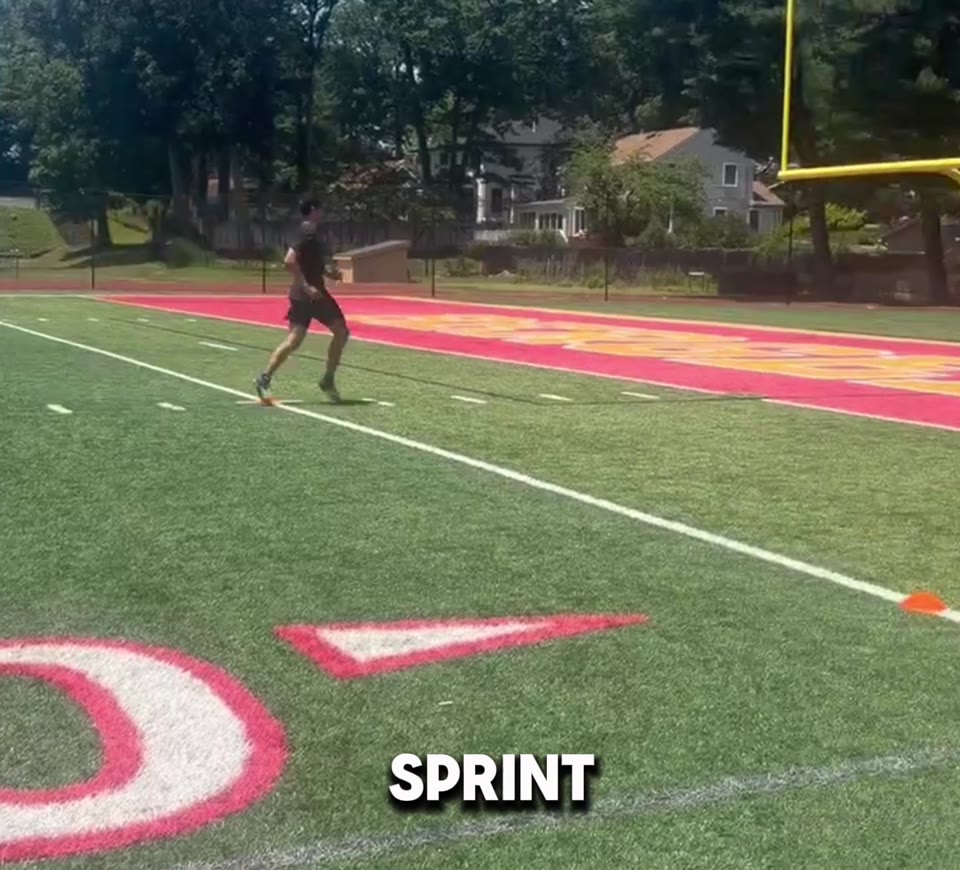
Sprint to the first cone: decelerate with 2 to 3 steps before the cut
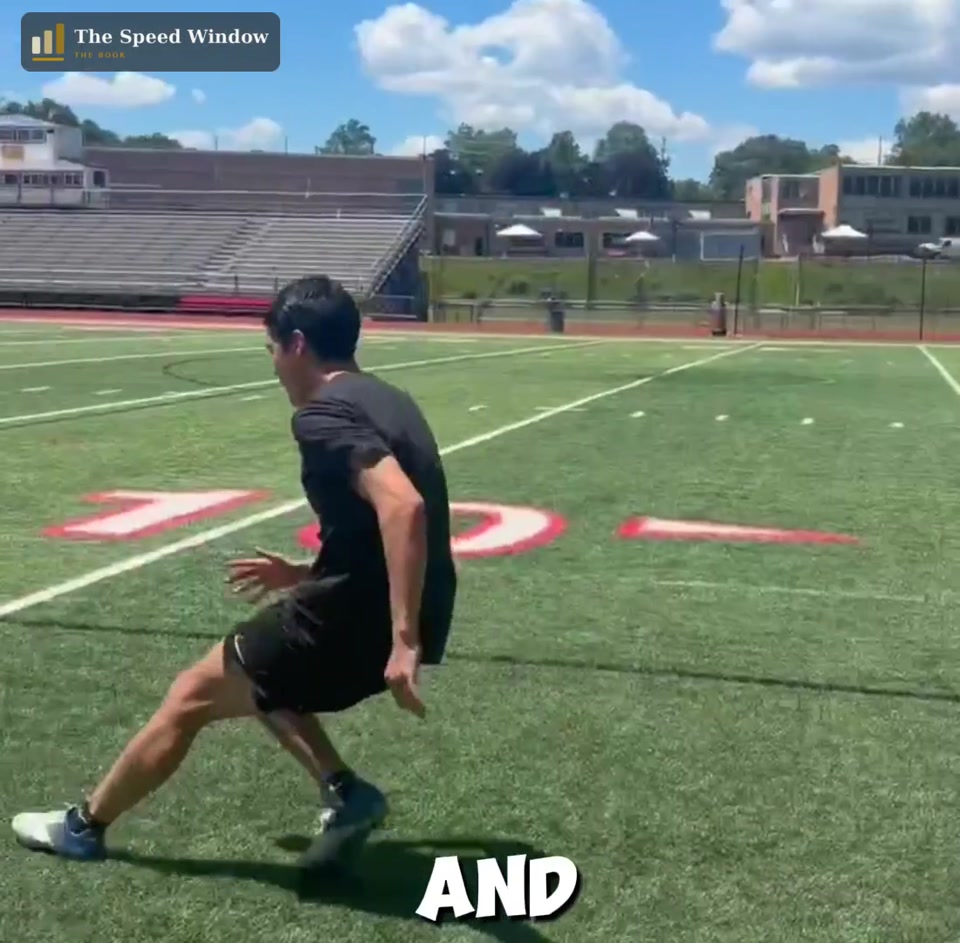
Run to the first cone at controlled speed. Begin decelerating 2 to 3 steps before the cone. Not at the cone. The plant foot should land with the hip low and the weight inside, ready to push.
Plant foot inside the cone: hip low, push with the outside leg
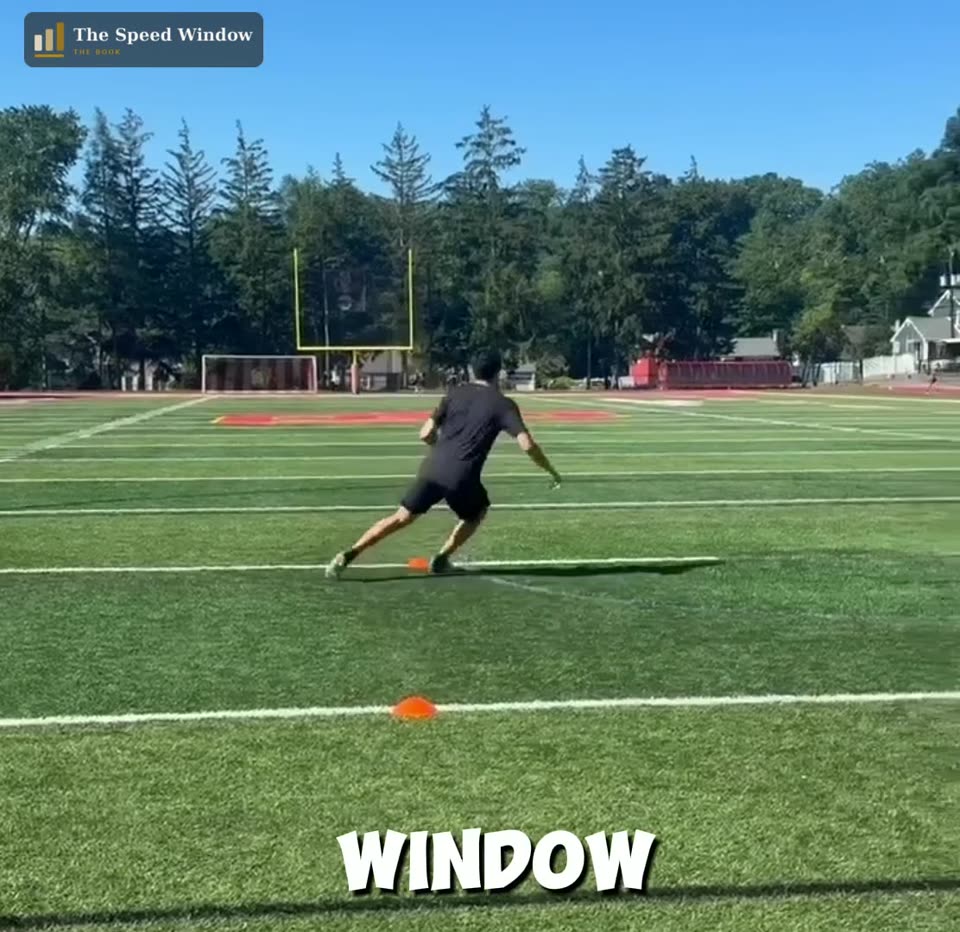
The plant foot lands on the inside of the cone (between the athlete and the far cone). The hip drops on the plant step. The push-off drives the body laterally toward the far cone, not backward. Avoid planting too wide or too close to the cone.
Run 10 yards to the far cone: same deceleration and cut mechanics
Sprint the full 10 yards to the opposite outer cone with the same deceleration and plant mechanics on the second cut. Identical mechanics, opposite direction.
Sprint back through the center: finish through, not at
Accelerate back through the center cone and continue 3 to 5 yards past it. Do not decelerate at the center cone. Run through the finish line.
Common Errors
What to watch for and how to correct it.
Cutting at too high a hip position: standing tall through the turn
The most common technical error. The athlete stays upright through the cut rather than lowering the hips before the plant. Cue: 'drop before the cone. Not at it.' The hip drop should begin 2 to 3 strides before the cone.
Crossover step at the cut
The athlete crosses one foot over the other to initiate the direction change rather than pushing off the outside leg. Cue: 'push off the outside foot, don't cross.' The push-off foot is the one planted at the cone, and it pushes laterally.
Knee valgus on the plant step
The plant knee collapses inward on the cut. This is the same pattern as in all the single-leg exercises: and in this context, it is the mechanics error most associated with non-contact knee injury. Cue: 'plant knee out. Push through it.' Address hip abductor strength if this persists.
Decelerating at the center cone on the return
The athlete brakes at the center finish cone rather than running through it. Cue: 'run through the middle, don't stop at it.' The finish line is 3 to 5 yards past the center cone.
Coaching Cue
The one thing to say when you need the rep to change.
"Drop early, push off the outside foot, run through."
These three cues address the three critical mechanics points of the Pro Agility: the early deceleration (drop early), the correct push-off pattern (outside foot), and the run-through finish (run through). They apply identically to both cuts (right-side and left-side) making them reusable across every rep of the drill.Progressions & Regressions
Where this drill fits in the sequence.
Regress to: if the athlete is struggling
- Deceleration Drill — 5-3-1: establish braking mechanics before the full Pro Agility pattern
- T-Drill: simpler four-cone pattern with the lateral shuffle component removed
- Lateral Shuffle: isolate the lateral push-off mechanics before integrating into a full agility drill
Progress to: once the pattern is clean
- Pro Agility (timed) add the stopwatch once the technical mechanics are consistent across 4 to 6 sessions
- Pro Agility — Max Effort (Force Window): full competition-speed version with timing gates
- T-Drill — Loaded. Add resistance to the T-Drill pattern to overload the cut mechanics
Programming Notes
When and how to use this drill in a session.
Run the Pro Agility — Technical on dedicated agility days in the Stabilization Window, after the deceleration drill and before any maximal-effort speed work. 4 to 6 reps with full recovery. Alternate the starting direction (right-first and left-first) equally across the set.
Run timed trials periodically (every 4 to 6 weeks) to establish a benchmark and track improvement. Do not time every session. The performance data is valuable; the technical feedback is more valuable and requires that speed not be the primary focus of most sessions.
Use the Pro Agility as a bilateral assessment tool every training block. Chart both directions. An athlete who cuts 0.3 to 0.5 seconds faster in one direction than the other has a meaningful agility asymmetry that deserves targeted attention.
Stabilization Window · Ages 12–15
Re-coordination through growth.
Growth disrupts movement patterns. This window focuses on re-establishing mechanics, building foundational strength, and preparing the body for the demands of force-based training.
Explore the Stabilization WindowEvery drill here comes from the book.
The Speed Window maps all three windows: what to train, when, and why.
Get the Book