Purpose
What this drill trains, and why it matters.
The Medicine Ball Scoop Toss trains explosive hip extension in a full-body expression that connects the lower-body power of the squat and deadlift to an upper-body output. The athlete drives from the hips and releases the ball overhead. The same pattern that drives a basketball pass, a volleyball serve, a shot put, and the upward component of any jump.
Unlike the kettlebell swing, which keeps the implement attached throughout, the medicine ball toss requires a complete power transfer and release. The athlete must fully express and then let go of the force they have produced. This teaches total-body coordination and power expression that complements the technical Olympic lifting work.
The scoop toss is accessible. Unlike the Power Clean or the Depth Jump, it requires no technical prerequisite movement skill beyond the hip hinge. It can be introduced early in the Force Window and used as a teaching tool for the hip extension pattern before the more technical lifts are ready. It is also a useful warm-up activation movement for the explosive training sessions.
Setup
How to position your athlete before the first rep.
Select a medicine ball that allows maximal effort
The ball should be heavy enough to require genuine hip drive but light enough that the athlete can launch it at full extension. Too heavy: the athlete strains rather than explodes. For most Force Window athletes, 4 to 6 kg is appropriate. 8 kg for strong older athletes.
Stand an arm's length from the wall
For the wall toss: stand close to a solid wall, about an arm's length away, hips square. Drive the ball up the wall as high as full extension carries it. Height comes from the hips, not the arms. For the overhead toss into open space: stand in an open area, toss overhead and behind.
Hold the ball with both hands below hip height. The scoop position
The starting position is a partial hip hinge with both hands holding the ball at or below hip height. Think of scooping. The ball starts low and the movement scoops it upward.
Execution
The drill, step by step.
Load the hips: aggressive countermovement
The athlete hinges the hips back, dropping the ball between the knees in an exaggerated scoop position. The loading is more aggressive than it might initially seem. The hip hinge is significant, the ball drops well below the hips.
Drive the hips forward: throw the ball upward using the entire body
From the loaded position, the athlete drives the hips forward explosively and launches the ball upward. The arms follow the hip drive. They do not throw independently. The feet may leave the floor at release if the power is maximal.
Release at full extension. Let the ball leave at the top
The ball is released at or near full hip extension, when the athlete is tallest and the force is greatest. Releasing too early means a lower trajectory; releasing too late means the ball goes behind. The release point is at the face or slightly above.
Catch on the return or collect from the floor
For wall tosses: catch the return. For overhead tosses into open space: collect the ball from the floor. Reset the starting position and repeat. Do not rush the reset: full reset before each rep.
Common Errors
What to watch for and how to correct it.
Using only the arms. No hip drive
The athlete throws the ball with the arms and shoulders without loading and driving the hips. This produces a weak, shoulder-strain-prone throw. Cue: 'the ball is thrown by the hips. The arms follow the hips.'
Ball releasing too early: low trajectory
The ball is released before full hip extension, producing a flat, low trajectory. Cue: 'throw it up, extend all the way before you let go.'
No loading phase: starting from upright
The athlete does not load the hips before the throw and starts from a standing position. The entire power advantage of the scoop pattern is lost. Cue: 'scoop it down, then launch it up. Load first.'
Coaching Cue
The one thing to say when you need the rep to change.
"Scoop deep (hips drive the throw) launch it up."
This cue is three sequential images: the loading (scoop deep (the ball drops well below the hips), the power source (hips drive the throw) not the arms), and the release direction (launch it up. Not forward, upward). Vivid for athletes because 'scoop' and 'launch' are natural movement images.Progressions & Regressions
Where this drill fits in the sequence.
Regress to: if the athlete is struggling
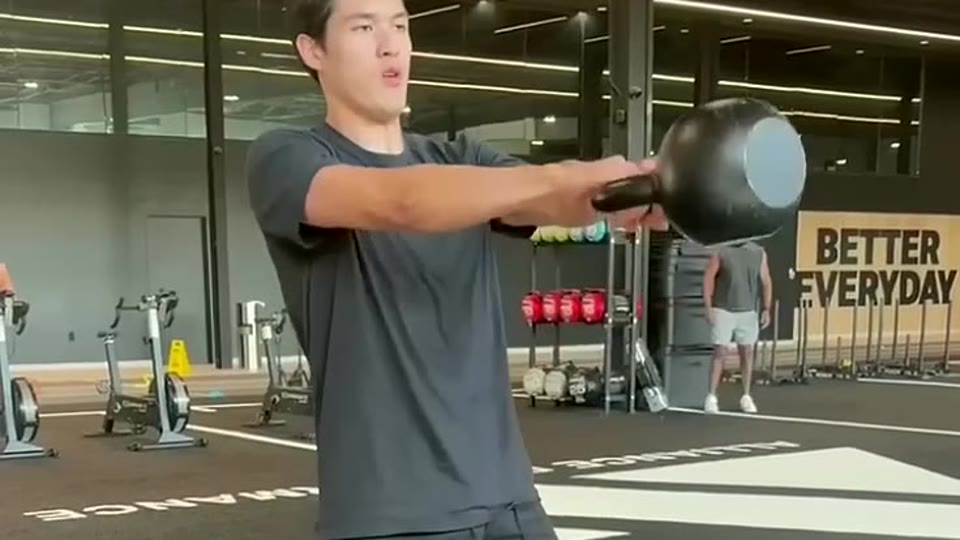
- Kettlebell Swing: same hip extension pattern without the release requirement
- Medicine Ball Slam: overhead to floor, trains hip extension in the downward direction
- Hip Thrust: if the athlete cannot demonstrate loaded hip extension in any form
Progress to: once the pattern is clean
- Single-Arm Medicine Ball Toss: unilateral version using a lighter ball
- Rotational Medicine Ball Toss: same drill from a rotational base, adds transverse plane power
- Medicine Ball Overhead Throw for distance: competitive testing version, measures total-body power output
Programming Notes
When and how to use this drill in a session.
Program the medicine ball scoop toss as a power development complement to the kettlebell swing and the Olympic lifting. Four sets of six to eight reps with ninety seconds of rest develops explosive power without high fatigue.
Use it as a warm-up tool for Olympic lifting sessions: three sets of six scoop tosses activate the hip extension pattern at submaximal intensity before the more technically demanding Power Clean or Hang Snatch work begins.
The medicine ball toss can also be used as a power assessment tool: measure the distance of a standard toss at the beginning and end of each Force Window training cycle. Improving throw distance is a clean measure of total-body explosive power development.
Force Window · Ages 15–18
Power on a proven foundation.
The athlete is physically ready for high-intensity training. Speed-power, strength, and explosive work are built on what the first two windows established.
Explore the Force WindowEvery drill here comes from the book.
The Speed Window maps all three windows: what to train, when, and why.
Get the Book