Purpose
What this drill trains, and why it matters.
The forward/back leg swing is a dynamic mobilization drill that takes the hip through its full flexion and extension range under gravity load. Unlike a static hip flexor stretch, the swing uses momentum to access range that passive stretching cannot: and it activates the muscles on both sides of the joint simultaneously during the movement.
This drill belongs in every Neural Window warm-up because it directly prepares the hip flexion pattern that the A-Skip and March Drill demand. Sprint mechanics require a hip that can flex quickly and completely, then extend powerfully. The leg swing builds that capacity in less than two minutes.
The forward/back swing also reveals hip asymmetry. Most young athletes will swing higher or more freely on one side. That difference is worth noting: unilateral hip restriction is a common contributor to gait asymmetry in sprinting and directional cutting.
Setup
How to position your athlete before the first rep.
Stand facing a wall, arm's length away
Place the hands flat on the wall at shoulder height for light balance support. The wall is a reference point. The athlete should not lean into it or bear significant weight through the arms.
Stand on the support leg with a slight knee bend
The standing leg is not locked out. A slight bend activates the stabilizers and keeps the athlete from locking the pelvis during the swing.
Relax the swing leg completely
The swinging leg should feel heavy and loose. The first two swings are always smaller: letting gravity establish the rhythm before the range builds.
Execution
The drill, step by step.
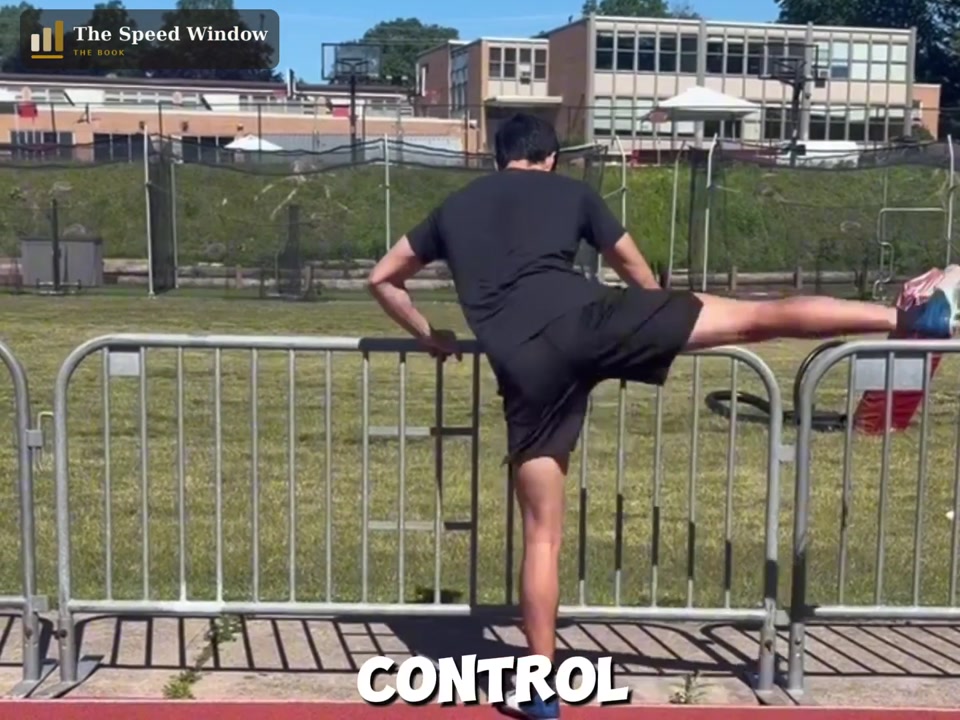
Swing the leg forward: knee slightly bent
Drive the leg forward until the hip reaches its natural end range. The movement comes from the hip, not the lower back. The back should not arch excessively as the leg swings forward.
Let it swing backward: controlled extension
Allow the forward momentum to reverse naturally, the leg swings backward into hip extension. The glute should activate at the back of the swing. Do not force the range. Let the pendulum motion build organically.
Build amplitude gradually: 5 small, 5 full range
The first 5 reps are moderate amplitude, warming the joint. The last 5 reach full available range in both directions. Forcing full range immediately before the tissue is warm can create sharp hip flexor responses.
Repeat on the other side
10 reps per leg. Rest is not needed between sides. Transition directly. The second leg benefits from the tissue warmth of the first.
Common Errors
What to watch for and how to correct it.
Swinging from the knee instead of the hip
The lower leg flaps independently while the upper leg barely moves. The entire leg should swing as a unit from the hip joint. Cue: 'swing the whole leg from the hip.' Demonstrate the single-pivot motion.
Leaning the torso forward on the back swing
As the leg extends behind, the athlete compensates by leaning forward at the waist rather than allowing true hip extension. Cue: 'stay tall. Let the leg go back without the torso chasing it.'
Locking the standing knee
The support leg straightens completely during the swing, which locks the pelvis and reduces the mobilization benefit. Cue: 'soft knee on the standing leg, slight bend throughout.'
Coaching Cue
The one thing to say when you need the rep to change.
"Whole leg, whole range. Stay tall."
'Whole leg' prevents the knee-flap compensation. 'Whole range' encourages full hip excursion as the tissue warms. 'Stay tall' prevents the forward lean on the back swing. All three common errors are addressed in four words.Progressions & Regressions
Where this drill fits in the sequence.
Regress to: if the athlete is struggling
- Joint Circles Series: establish basic hip circle mobility before adding the swing dynamic
- Static hip flexor stretch. Use if hip range is severely restricted before attempting a dynamic swing
Progress to: once the pattern is clean
- Leg Swing. Lateral (follows this drill in the warm-up sequence)
- Walking knee hug: adds a knee drive to the forward swing to increase hip flexion depth
Programming Notes
When and how to use this drill in a session.
Program immediately after Joint Circles Series in every Neural Window warm-up. The sequence is: circles to loosen the joints, then swings to take those joints through dynamic range under load. Forward/back swings precede lateral swings every time.
10 reps per leg, both directions of swing. No rest between legs. The entire sequence takes under 2 minutes and is never optional. The hip flexion and extension range it activates is the exact range that sprint mechanics demand.
Run it every session regardless of which drills follow. If the session is sprint-focused, the hip activation is essential. If the session is agility-focused, the single-leg stability of the swing warm-up is still directly relevant.
Neural Window · Ages 7–12
The critical learning window.
Between ages 7 and 12, the nervous system acquires movement patterns faster than at any other stage of development. The drills trained here are not fitness drills. They are wiring sessions.
Explore the Neural WindowEvery drill here comes from the book.
The Speed Window maps all three windows: what to train, when, and why.
Get the Book