Purpose
What this drill trains, and why it matters.
The Pro Agility at maximum effort is the Force Window's primary timed change-of-direction assessment and training drill. Where the Stabilization Window's Pro Agility — Technical focused on mechanics, deceleration quality, and cutting precision, the Force Window version demands both: clean mechanics executed at full speed under time pressure. The athlete must now produce everything they learned at slower speeds: at maximum intent.
The 5-10-5 (also called the 20-yard shuttle) is one of the most recognized athletic performance assessments in sport. It directly measures the ability to accelerate, decelerate, reverse direction, re-accelerate, decelerate again, and reverse: all within a 10-yard corridor. This sequence appears in every invasion sport: football routes, basketball defensive slides, soccer tracking runs, and lacrosse ground balls all require this pattern.
The Force Window athlete's advantage over the Neural and Stabilization Window version is not just speed. It is force production. The ability to apply more ground contact force during the cuts, to decelerate more quickly, and to accelerate out of the cut more explosively is a direct product of the strength and power development built in this window. Athletes who have developed the Back Squat, Trap Bar Deadlift, and Broad Jump first will cut faster. The connection is direct.
Setup
How to position your athlete before the first rep.
Set three cones in a straight line: 5 yards apart
Cone A at the center. Cone B five yards to the right. Cone C five yards to the left of Cone A (or 10 yards from Cone B). The athlete starts straddling Cone A, one foot on each side of the center line.
Establish the starting position and first direction
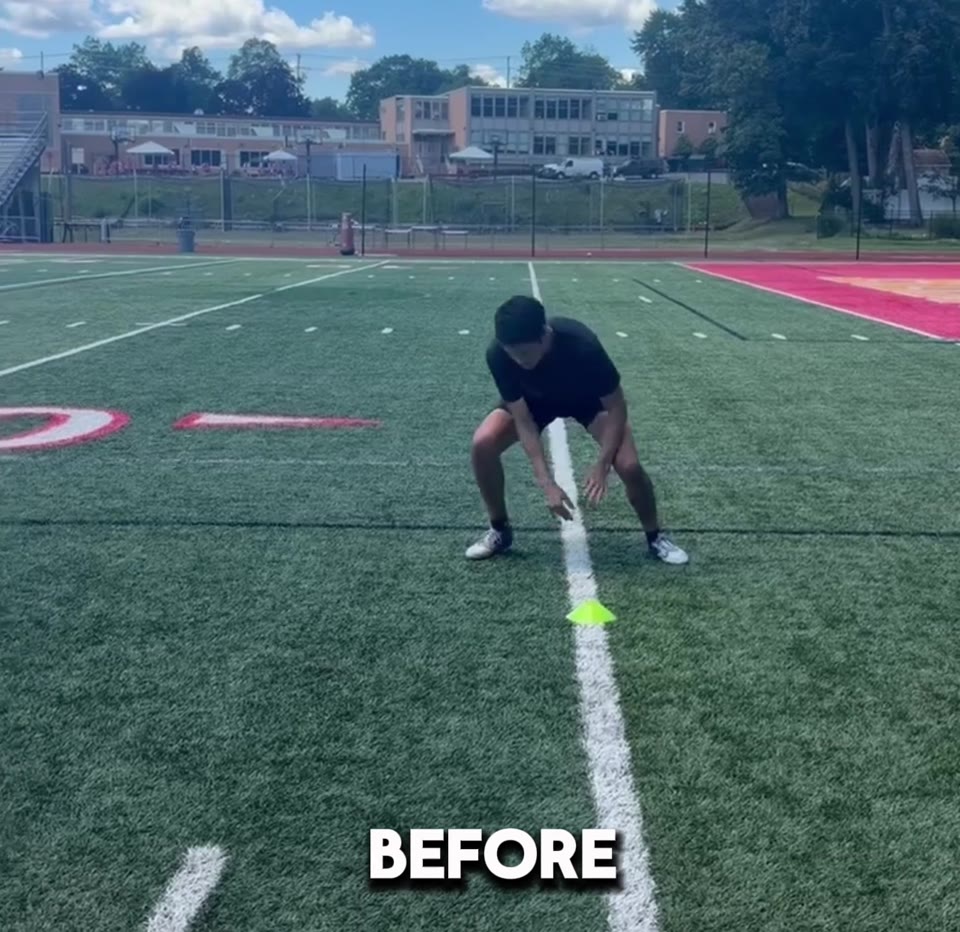
The athlete chooses which direction to run first (right or left: both should be tested). They straddle Cone A in a two-point stance with a forward lean and the foot on the first-direction side slightly forward.
Use a timer: get a baseline time before training
The drill only develops at maximum effort if it is timed. Get a baseline 5-10-5 time in the first session. Test periodically (every four to six weeks) to measure change-of-direction speed development.
Execution
The drill, step by step.
Sprint to the first cone: decelerate precisely
The athlete sprints five yards to the first cone with maximal acceleration. The deceleration begins approximately two yards before the cone. Not at the cone. Plant the outside foot just outside the cone line.
Plant and cut: low center of mass, outside foot
The cut is made off the outside foot, planted slightly inside or at the cone. The hip drops as the foot plants: a low center of mass cuts faster than an upright one. The inside arm drives toward the new direction.
Accelerate the full 10 yards to the second cone
From the first cut, the athlete accelerates the full ten yards to the second cone. This is the longest acceleration phase of the drill and requires sustained drive-phase mechanics. Not an early stand-up.
Cut again: sprint the final 5 yards through the finish
Plant and cut at the second cone exactly as at the first. Sprint the final five yards back through the center cone (Cone A), running through the finish rather than decelerating before it.
Common Errors
What to watch for and how to correct it.
Decelerating too late: overrunning the cone
The athlete decelerates too close to the cone and either touches the cone, loses the cut, or stumbles on the direction change. Deceleration must begin 1.5 to 2 yards before the cone. Cue: 'brake early (cut smooth) then launch.'
Upright cutting position: high center of mass at the plant
The athlete does not drop the hips at the plant point and cuts from a tall position. This reduces the mechanical advantage at the cut and increases lateral knee stress. Cue: 'hips low at the plant, get under it.'
Not driving through the finish
The athlete decelerates before reaching Cone A on the final sprint. This not only costs time but fails to train the pattern of full acceleration through the completion of a change-of-direction sequence. Cue: 'finish through the cone. Do not slow down before you cross it.'
Coaching Cue
The one thing to say when you need the rep to change.
"Brake early (cut low) sprint all the way through."
This is a sequence cue for the three critical transitions of the drill: the deceleration quality (brake early (not at the cone), the cut position (cut low) hips down), and the final acceleration (sprint all the way through. Do not ease off before the finish). Run through all three before every timed attempt.Progressions & Regressions
Where this drill fits in the sequence.
Regress to: if the athlete is struggling
- Pro Agility — Technical (Stabilization). Return to technical, mechanics-focused version at reduced speed
- L-Drill: three-cone drill that develops directional changes within a smaller space
- T-Drill — Loaded (Stabilization): builds multi-directional speed with mechanics emphasis
Progress to: once the pattern is clean
- Pro Agility with a tennis ball reaction start: coach drops a ball, athlete reads the direction and reacts before running
- Pro Agility with sport-specific start: from a defensive stance, a sprint stance, or a jump landing
- Pro Agility timed test: compete against personal best time, tracked quarterly
Programming Notes
When and how to use this drill in a session.
Program the Pro Agility at max effort four to six timed attempts per session with full recovery between reps. This is a power and speed exercise. It is not a conditioning circuit. Rest three to four minutes between attempts.
Use the 5-10-5 time as a key performance indicator for Force Window athletes. Test at the start of each training cycle and again at the end. A faster 5-10-5 time is the aggregate result of the strength, power, and sprint work done in the Force Window.
Run both directions equally. Most athletes have a dominant cut direction and a weaker one. Train the weaker direction intentionally. Add one or two additional reps on that side per session until the asymmetry closes.
Force Window · Ages 15–18
Power on a proven foundation.
The athlete is physically ready for high-intensity training. Speed-power, strength, and explosive work are built on what the first two windows established.
Explore the Force WindowEvery drill here comes from the book.
The Speed Window maps all three windows: what to train, when, and why.
Get the Book