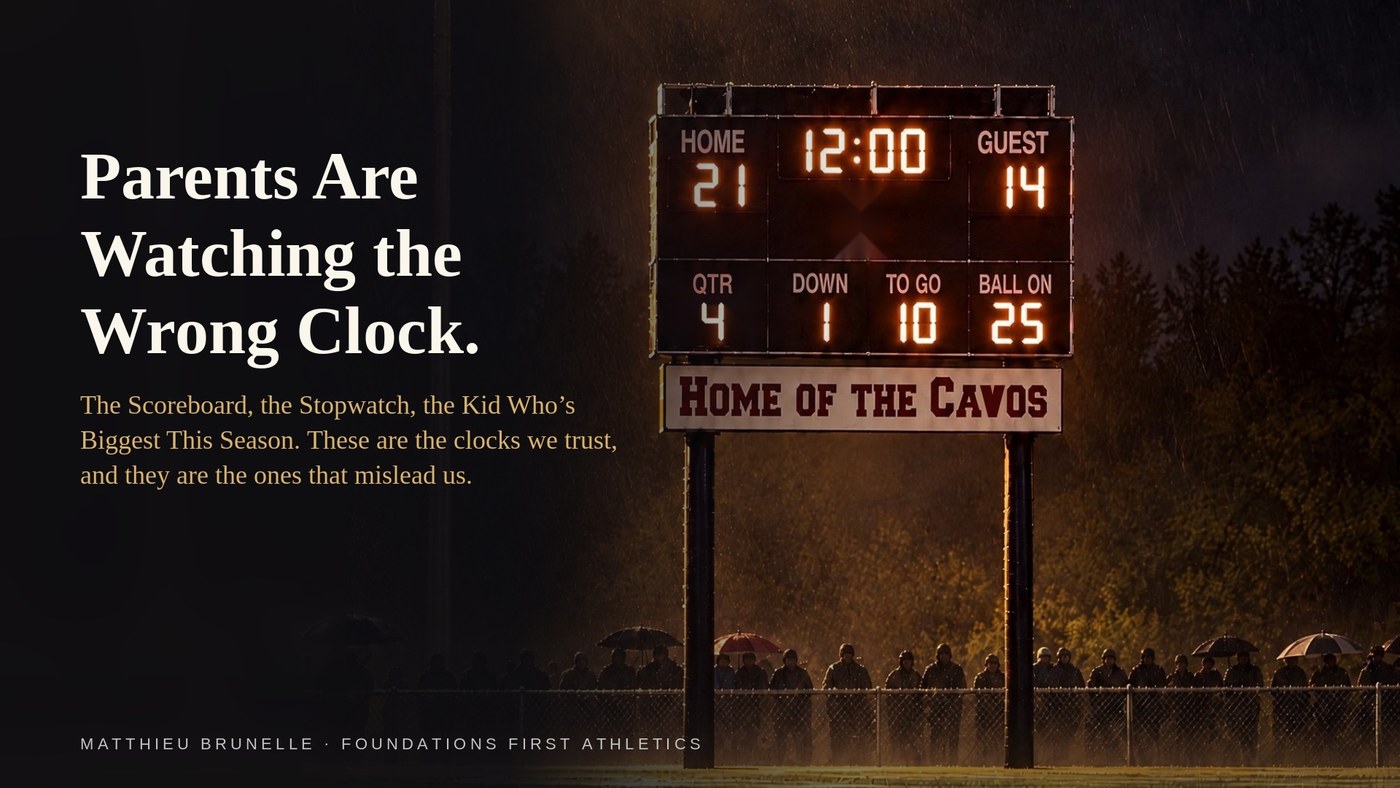
It is raining on a Friday night, and nobody has left.
Umbrellas line the fence. The scoreboard over the end zone glows through the weather: 21 to 14, fourth quarter, twelve minutes left. Every parent in the stands knows exactly how to read it. It tells them who is ahead, how long is left, and what it all means.
We are good at reading clocks. The scoreboard is one. The stopwatch is another, a forty-yard time written on a clipboard. The third is the quietest and the one we trust most: the kid who is biggest this season.
All three answer the same question. Who is ahead right now?
Right now is the one place a growing child never stays.
The Other Clock
A second clock exists, and very few people see it.
It runs inside the kid. It opens a biological window, then a second, then a third. Each one closes on its own schedule, whether anyone is paying attention.
A child goes through this once. One childhood. One trip through puberty. There is no second pass.
Before puberty, the nervous system is the body's software, and it is being written: how to move, how to stop, how to keep rhythm at speed. The hormones that build muscle haven't arrived yet. Then puberty brings them, and the hardware comes online: strength and power. Software first. Hardware second. Learn it later, and it can cost more.
Nobody gets locked out. But good timing only comes around once.
The league doesn't run on the body's schedule. Neither do the tournaments, the tryout dates, the rankings, or the coach who needs a win by Saturday. They run on birth years and registration deadlines. They were built for grown-ups and then handed to children.
The two clocks do not agree. And the biological one won't change for youth sports. It never has.
Picture two ten-year-olds in the same bracket. One spends the window on the right work, in the right order. The other spends it on a bigger schedule and more games. Eight years later they can end up as completely different athletes, and nobody remembers the year that decided it.
That is the whole problem. Not bad parents. Not bad coaches. Two clocks, one kid, and only one of them being watched.
The Biggest Study on Late Bloomers in Sports
Researchers led by Arne Güllich reviewed the research on elite performers and published it in Science in 2025. Nearly ninety percent of the top international juniors and the top international adults were different people.
Put another way, roughly nine out of ten adults who reach the top were not stars at twelve. Read it both ways. A star at twelve has no guarantee. A kid overlooked at twelve has not hit a ceiling.
No study can tell you whether your child is an early star or a late bloomer, and you should walk away from anyone who says it can.
Your kid is not behind. They are early.
The Kid Who Got Cut: The Relative Age Effect
Think about the child cut at eleven.
That child was not less talented. They may have been younger, in a system that rewarded being older. A January birthday and a December birthday land in the same bracket, almost a full year apart. At nine, a year is a mountain. The bigger kid gets picked. The picked kid gets the coaching and the games. The system thinks it found talent. It found birth dates.
Here is what the stopwatch can't see. Athleticism is a skill first. The physical quality comes second. The child learning to move well right now is building the thing everything else sits on.
Keep Them In The Game
Youth sports didn't get this intense overnight. It became an arms race through a long run of reasonable decisions, each one made by a parent trying to protect their kid. Don't submit to the arms race. Not because caring is wrong. Because the race is run on the wrong clock, and more is not better. Timing is.
Athletic development is a sequence. It has an order.
And whatever else you do, keep them in the game. The kid still playing at seventeen has years of the right work behind them. The kid cut at eleven who quits at twelve never finds out who they were going to be. They can lose more than a sport. Confidence. Friends. A body that learned to move and then stopped being asked to. Those losses can last a lifetime.
Patience isn't waiting. It is protecting the window and staying steady when the room is panicking.
The Clock That Matters
Back at the fence, the rain keeps coming. In a few minutes the scoreboard will say final, and everyone will know who won.
It will say nothing about the clock that matters. That one is running inside the star on the field. It is also running inside the kid in the third row, hood up, who was cut at eleven, quit at twelve, and is watching old teammates play without him.
Same age. Same clock.
The clock never stopped for that kid. Only the work did. And a name left off a list at eleven was never a ceiling.
What gets built in these years is bigger than a roster spot. It is how to move, balance, stop, and stay in control: the foundation of a body that can carry a person well past the last game they ever play.
The scoreboard stops at zero. The clock inside a kid keeps running.
Your kid is not behind. They are early.
The Speed Window is the parent's guide to the clock that matters. Buy the paperback direct for $17.99, or find it on Amazon.
Sources: Güllich et al., Science, 2025 · Related: The Sorting · I Watched a World Record at the State Meet · The Arms Race
Which window is your athlete standing in?
Find out in ten seconds, then see what the right work looks like at their stage.
Find Your Athlete's WindowThe Speed Window maps the whole sequence.
The windows, the order, and what to train in each one, in plain language with the full drill library. Buy the paperback direct and save $2, or get it at Amazon.
Already read it? Leave an honest review on Amazon. It is the most useful thing a reader can do for the next parent.