I was on the infield, warming up.
Then everybody stopped. All of a sudden, everyone was saying the same thing: let's go watch the race. I didn't really understand why. It was a girls' race. I went over anyway.
It was June 2017, the New Jersey group championships in Egg Harbor. I was a freshman, the fourth-fastest on a 4x100 relay that had made the state meet. Making it was the goal, and it was a huge accomplishment. I felt on top of the world. I also knew plenty of better, faster athletes across the state didn't make it to the state meet. That's why I felt proud and lucky.
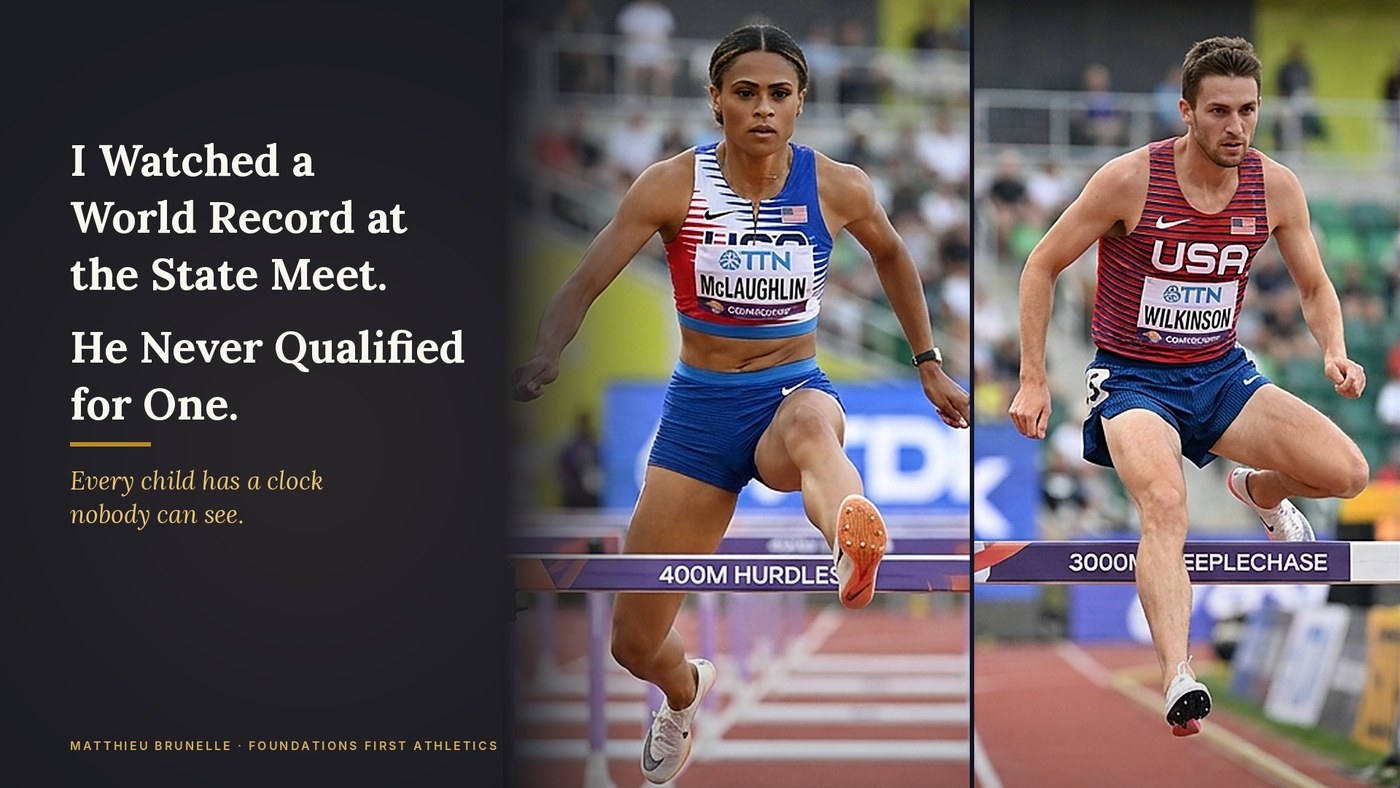
What I was about to see, I will never forget. It's still vivid. Sydney McLaughlin ran for Union Catholic. She was a senior, back from the Rio Olympics the summer before. She won the 400-meter hurdles in 54.03, a world record for athletes under 20.
It was an unbelievable display. Her mechanics were graceful: every stride matched the last, nothing wasted, nothing forced. She met each hurdle the same way she met the last. The power showed in how she drove off every landing. The speed never let up.
I couldn't take my eyes off her. Not when the hurdles ended. Not until she came back and ran the 400 in 51.88. Now I understood why everybody had stopped. You know when you're looking at something rare. I have been watching her ever since. #GoSydGo
I made it back to the state meet my junior and senior years, in the long jump and the triple jump. At the New Jersey State Indoor Meet of Champions my senior year, I finished ninth in both. I'm still proud of that.
Then I think about the kids who weren't there. I don't know how many athletes quit because they fell short of a goal at a young age. Nobody keeps the count. The meet was a line, and I landed on the right side of it.
The one who never made the meet
Matt Wilkinson never landed on the right side of it. He ran distance for Minnetonka High School in Minnesota and never qualified for a state meet. Qualifying is a number, and his wasn't fast enough. In 2024, he ran in the Olympics.
In June of that year, he stood at the U.S. Olympic Trials in Eugene, Oregon, with one barrier left in the 3,000-meter steeplechase. He cleared it, lifted his arms, and crossed the line second in 8 minutes, 23 seconds, stunned by what he'd just done. That August, at the Paris Games, he finished sixth in his heat in 8:16.82, less than a quarter of a second off his lifetime best. Only the top five advanced. He missed the final by one place.
The road behind that was not a straight line. He kept running after high school, at Carleton, a Division III school, where he tried the steeplechase for the first time. He moved to the University of Minnesota as a graduate transfer. About a year before the Games, he was applying for jobs outside of running. The qualifying list had been accurate for his high school years. It was also taken early.
So that's three of us. The stopwatch could see her. It gave me a spot. It had almost nothing to say about him yet. From the stands, you can't tell who is early and who is on time. She is the exception. Most kids are not her. Most are running a different schedule.
The clock nobody can see
That schedule is biological. The stopwatch and the scoreboard are the clocks everyone can read. Every child also runs on a clock nobody can see, a biological clock for athletic development, and it opens at different ages for different kids. I call it the Speed Window, and it has three stages. Inside those stages, a young athlete's future potential gets shaped.
The Neural Window, about ages 7 to 12, is when the nervous system learns to move: coordination, rhythm, balance, clean mechanics. The Stabilization Window, about 12 to 15, covers the growth years, when puberty reshapes the body and mechanics matter more than intensity. The Force Window, about 15 to 18, comes last, when the foundation can finally become real strength and speed. Those ages are the center of a range, not a gate. Girls typically move through them a year or two ahead of boys, and two kids the same age can be standing in different windows.
None of this makes McLaughlin and Wilkinson the same story. She's a hurdler, he's a distance runner, and the Windows were built around speed, agility, and strength in young athletes. I'm not claiming they explain either career. His road ran through a new event, a new school, and a year of weighing a job outside the sport. Almost no one reaches the Olympics, cut or not.
What his story does show, two years later, is how early lists can get the future wrong. A 2025 study in Science looked at nearly 35,000 top performers, from Olympic medalists to chess masters, and found that the best young performers and the best adults are mostly different people. Sorting kids at ten or twelve can reward whoever is ahead on the clock everyone can see. The kids behind on that clock can be right on time on the other one.
If your kid missed the mark
So if your child missed the qualifying mark, got cut, or was told they weren't ready, start here. Stop reading the list as a future projection of athletic potential or achievement. Watch the child, not the birthday, and work out which window they're standing in. Then give them the right work for that stage, and keep them in the game long enough for it to matter.
Your kid is not behind. They are early in a sequence.
Matt Wilkinson never made the state meet. The years after were still coming.
That's why I wrote The Speed Window. It maps all three windows in plain language, so you can look at your own kid and know what they need next. The first three chapters are free, and the book is available now on Amazon.
Sources: NJ MileSplit, All-Group records at Egg Harbor, June 2017 · Star Tribune, Wilkinson second at the U.S. Trials · Gopher Sports, Paris result · Carleton Athletics, Paris result · Güllich et al., Science, December 2025 · Related: The Sorting
Which window is your athlete standing in?
Find out in ten seconds, then see what the right work looks like at their stage.
Find Your Athlete's WindowThe Speed Window maps the whole sequence.
The windows, the order, and what to train in each one, in plain language with the full drill library. Available now.
Already read it? Leave an honest review on Amazon. It is the most useful thing a reader can do for the next parent.