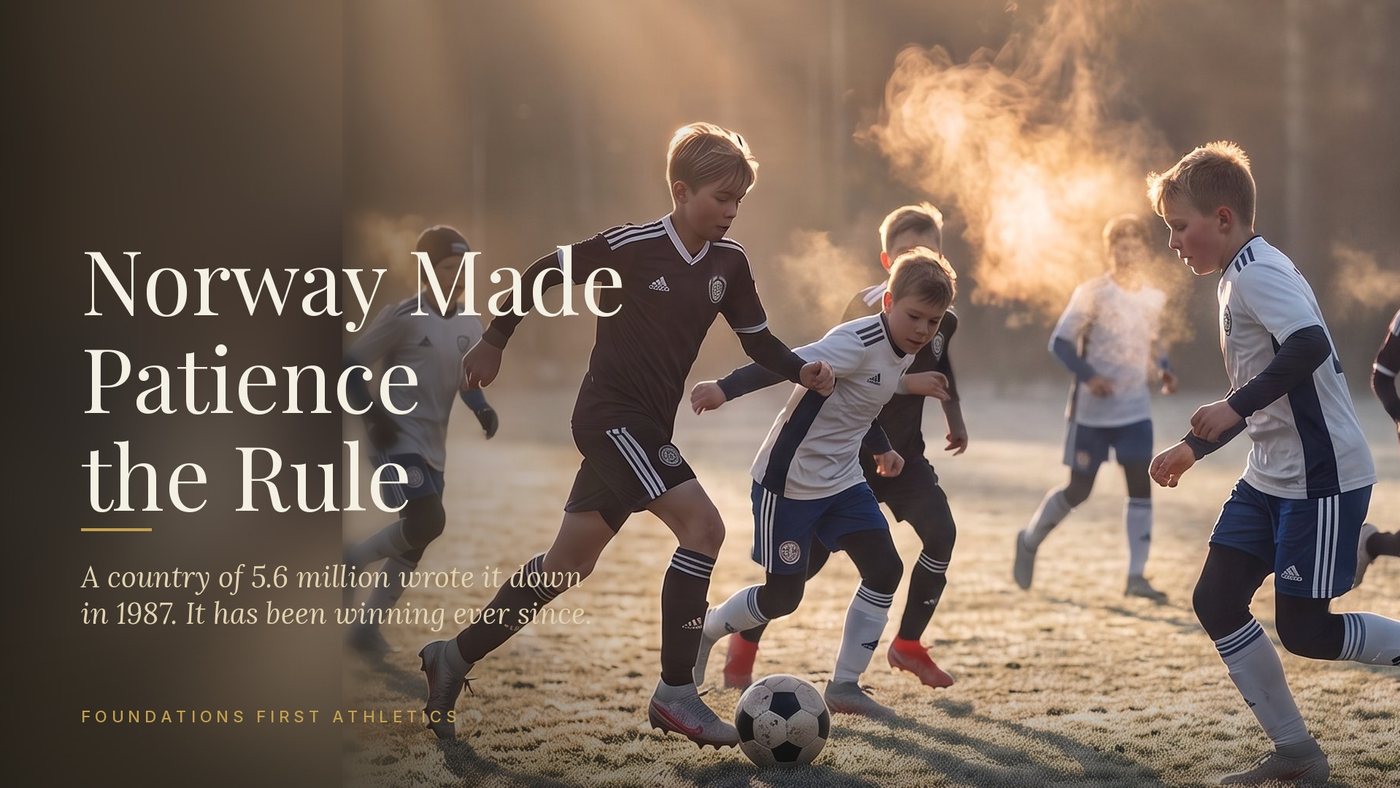
It's a Saturday morning in October. A soccer field somewhere outside Oslo.
Twelve-year-olds are playing. Parents stand along the field, coffee in hand. The game starts. The game ends. The boys walk off the field. And nobody is deciding their future.
They're not expected to win a championship. No cut list. No elite team to earn a spot on. No selection camp waiting for them in the spring.
Norway has all of those things. But for a twelve-year-old, they're still a long way off.
That's not just a club's coaching philosophy. It's the way the country has designed its youth sports system, written into the national rulebook.
The rule
In 1987, the Norwegian Confederation of Sports adopted the Provisions on Children's Sport. The rules have been revised a few times, but the core principle has remained: every league and club plays by them.
Local competition can begin the year a child turns six. But no standings or rankings until they're eleven, and even then, only "if appropriate." No national, European, or world championships until the year after they turn twelve.
Put simply, you can't become a national champion before you're thirteen.
And the rules don't stop at competition.
A companion document, Children's Rights in Sport, lays out what every child should be able to expect: a safe place to play, friendship, fun, the chance to learn, and the freedom to choose their sport. Money shouldn't determine whether they get to play.
American youth sports are still debating many of these same questions in parking lots, youth clubs, and parent group chats.
Norway put its principles in writing nearly forty years ago. They built patience into the policy.
Then they went out and won everything
It sounds soft. It sounds like a country that hands out participation ribbons.
Look at the medal table.
Milan Cortina, this past February. Norway finished first with 41 medals and 18 golds. The United States finished second with 33 medals and 12 golds, and those 12 golds were the most we have ever won at a Winter Games.
Norway has 5.6 million people. We have 340 million. That is sixty Americans for every Norwegian, and they beat us by eight medals.
This wasn't a one-time result, either. Norway has led the medal count and the gold-medal count at each of the last three Winter Olympics. It also holds the all-time records for both at the Winter Games.
For a country of that size, it's an extraordinary record.
This isn't a country that turned its back on winning. It's a country that has found a way to pursue excellence without demanding that children become champions before they're thirteen.
They didn't eliminate ambition. They changed when, and how, it enters a child's life.
And maybe that's the part worth paying attention to.
What Norway took out
The rules are not really about ribbons. What they take out is the urgency.
Picture two dads in a parking lot after practice. One mentions his twelve-year-old is taking the winter off. The other lowers his voice and says the winter club is where the A team gets picked, and the kids who skip it never catch up. By the time they reach their cars, the first dad is looking up registration on his phone.
Neither of them meant any harm. But they made a decision about a twelve-year-old out of fear in under three minutes.
That conversation doesn't happen in Norway. No A team gets picked at twelve. No championship to qualify for, no door closing, and nobody can sell you a key to a door that doesn't exist.
That is what the rules actually do. They make patience the default, not an act of courage.
Here, patience is something a parent chooses alone, against everyone else in the parking lot. Every late-night text, every showcase invitation, every ranking that did not exist three years ago carries the same message: if you are not doing more, you are falling behind. Parents are not naive. They are being sold something, and the product is urgency.
In Norway, nobody gets to sell urgency to the parents of a twelve-year-old, because a twelve-year-old has nothing to be urgent about.
Why it works
Norwegians aren't against competition. Far from it. Their adults compete with incredible intensity. Erling Haaland and every player on the Norwegian World Cup team that made the quarterfinals grew up under these same rules. So did nearly every Norwegian athlete who has stood on an Olympic podium over the past fifteen years.
The difference is that Norway doesn't ask children to prove they're worth investing in before they've had a real chance to develop.
The thinking is pretty straightforward. Ask a Norwegian sports official why they hold off on early selection, and you'll often hear some version of the same answer:
Nobody knows at eight, ten, or twelve who will be an elite athlete.
The research backs up that idea. This summer, I wrote about a study that followed tens of thousands of elite performers. It found that the athletes who ranked among the best juniors and those who became the best adults were different people nearly nine times out of ten.
Norway built its youth sports system around that basic understanding before the study ever existed.
The issue with early rankings is they often tell us more about development timing than long-term potential. Who hit their growth spurt first? Who was born in January instead of December? Whose family could afford the extra training, travel, and seasons?
A standings table at twelve can look objective. It can look scientific. But it may be measuring the wrong things entirely.
The Aspen Institute surveyed nearly 4,000 American children ages ten to seventeen. Among those who quit a sport, the average age they walked away was just under thirteen.
The number one reason they gave? "I'm not good enough."
A twelve-year-old decides they're not good enough, gets sorted out, and walks away from the sport.
A year before Norway would have even allowed that child to compete for a national championship.
What they got right
The years Norway keeps out of championships run through age twelve. That lines up almost exactly with what I call the Neural Window, the stretch from about seven to twelve when a child's nervous system is doing its most important work.
Rhythm, coordination, balance, reaction, the basic mechanics of running fast. All of it is learned best with short distances, low fatigue, plenty of variety, and a kid who is not afraid of being measured.
The nervous system learns through repetition. It does not learn through urgency.
Around thirteen, Norway opens the door to national competition. That is the front edge of the Stabilization Window, when growth arrives, the body reorganizes itself, and structured competitive training starts to make sense.
Norway's calendar and the developmental calendar line up. That is what happens when a country writes its rules around the child instead of the tournament.
We run it backward. We rank at eight, cut at ten, specialize at eleven, and then act surprised when the kid quits at twelve.
We pull the fruit off the tree in April and blame the tree.
What this does not say
Norway is a small country with a sports system funded partly by a national lottery and run mostly by volunteer parents. You cannot import a country. The provisions are confederation regulations, not law, and Norwegian coaches will tell you they get bent in some clubs and argued over in others. None of that travels. A parent in Ohio has to work with the league in front of them.
So I am asking a simpler question.
Look at what the best winter sporting nation on earth decided was true about children. Then look at what your local league decided. One was built on how kids develop. The other was built on a schedule.
What you can take from it
You probably can't rewrite a league's rulebook. You can't change the registration deadlines, the selection process, or the pressure coming from parents.
But you can write your own rulebook at home, and that's where it starts. Take the urgency out first.
When the next opportunity comes along (a tryout, a winter club, a text from another parent, a registration deadline), pause before you say yes.
Ask yourself one question:
What actually closes if we say no this time?
For a twelve-year-old, the honest answer is usually: not much. The door you're being told you can't miss? It probably isn't the only door.
Stop refreshing the standings.
Your kid's team record tells you about the team. It doesn't tell you everything about your kid.
Let the score matter for ninety minutes. Then let it go.
Two or three sports through age twelve isn't indecision. It's building a broader foundation. Different sports challenge the body in different ways. Different movements, different decisions, different ways of solving problems. Let them experience them.
Measure the year by what your kid can do in December that they couldn't do in September.
Improved skills. Better footwork. Learning to stop under control. Better anticipation and understanding the game. Improved physical development.
Those are the results that matter, and the league doesn't publish them. You have to keep track of them yourself.
And when your kid gets cut at twelve, remember this: in Norway, nobody would have been allowed to decide that his competitive future was already over.
That doesn't mean the cut won't hurt. It doesn't mean every child will become an elite athlete. It means one early decision doesn't have to define the rest of the story.
Your kid isn't behind. He's still developing.
The system just couldn't wait for him. That's the whole job.
Not more sessions. Not automatically joining the winter club. Not chasing every opportunity because you're afraid someone else is getting ahead. It's patience, in a culture that has turned impatience into an industry.
Norway made patience the rule, so parents didn't have to be brave alone. Here, you have to choose it. On purpose. Every season.
Somewhere right now, a twelve-year-old is walking off a field where nobody decided anything about his future.
He played. He learned something. He went home, and he's going to be fine.
Nobody sorted him out. Somebody gave him time.
Norway wrote that down almost forty years ago. Your rulebook can say the same thing.
Sources: Norwegian Confederation of Sports, Provisions on Children's Sport and Children's Rights in Sport · Milan Cortina 2026 medal table · Güllich et al., Science, 18 Dec 2025 · Aspen Institute National Youth Athlete Survey · Related: The World Cup Filled the Fields, The Sorting
Norway wrote its rules around the windows. You can too.
Find out which window your athlete is standing in, and what the right work looks like at their stage. It takes ten seconds.
Find Your Athlete's WindowThe Speed Window maps the whole sequence.
The windows, the order, and what to train in each one, in plain language with the full drill library. Available now.
Already read it? Leave an honest review on Amazon. It is the most useful thing a reader can do for the next parent.