Purpose
What this drill trains, and why it matters.
The dumbbell row is the Stabilization Window's primary upper-body pulling exercise and the direct complement to the push-up progression from the Neural Window. Pulling strength and pushing strength must develop together. An athlete who has built push-up strength for two years without a corresponding pulling pattern has a significant scapular stability imbalance that will surface as shoulder problems under Force Window loading.
The single-arm dumbbell row also trains core anti-rotation: the ability to resist trunk rotation while one arm pulls. This anti-rotation demand activates the obliques and deep spinal stabilizers in a way that bilateral rowing exercises do not. For an athlete whose core stability is being rebuilt during the growth phase, the anti-rotation component of the dumbbell row is as valuable as the pulling strength component.
Load selection is important. Athletes in the Stabilization Window routinely select dumbbells that are too light to create a real training stimulus, or too heavy to allow full scapular retraction. The correct weight is one that allows 10 clean reps with full retraction on every rep. The scapula should be visible moving toward the spine on each pull.
Setup
How to position your athlete before the first rep.
Brace stance: knee and hand on bench, working side free
Place the same-side knee and hand on the bench for support. The body should be nearly horizontal: back parallel to the floor. The working-side foot is on the floor for stability. The non-working hand provides a firm base.
Dumbbell hangs straight down from the working shoulder
The starting position has the dumbbell directly below the shoulder, arm fully extended, and the scapula slightly protracted. This is the full bottom of the range. Not partway down.
Neutral spine throughout
The back should be flat. Not rounded, not arched. Check the low back specifically. Athletes who have not yet established core stability will round the lumbar spine as the dumbbell gets heavier.
Execution
The drill, step by step.
Initiate with the scapula: retract before elbow bends
The first movement of the row is a scapular retraction. The shoulder blade pulls toward the spine before the elbow begins to bend. Coaches should be able to see the scapula move first. Athletes who lead with the elbow skip the most important part of the exercise.
Drive the elbow toward the hip. Not toward the ceiling
The elbow travels back and slightly toward the hip, not straight up toward the ceiling. The elbow-toward-ceiling path creates excessive shoulder internal rotation. The elbow-toward-hip path maintains a neutral shoulder position throughout the pull.
Reach full range: elbow past the body, dumbbell at ribcage
At the top of the rep, the elbow should be past the plane of the body and the dumbbell should be at or near the lower ribcage. Partial range rows are less valuable and usually indicate too heavy a weight.
Control the descent: full extension before the next rep
Lower the dumbbell back to the starting position with a controlled 2-count descent. Return to full arm extension at the bottom. The scapula protracts slightly at the bottom: allowing the shoulder blade to move through its full range.
Common Errors
What to watch for and how to correct it.
Leading with the elbow. No scapular initiation
The most common error across all experience levels. The elbow bends immediately from the bottom position, skipping the scapular retraction. The lat and rhomboid are underactivated. Cue: 'shoulder blade first, then pull the elbow.' Have the athlete practice scapular retraction in isolation before the first working set.
Trunk rotation: opening the torso toward the pulling arm
The athlete rotates the trunk toward the pulling side to gain momentum or extra range. This removes the anti-rotation demand. Cue: 'hips and shoulders stay square, only the arm moves.' Drop the weight if trunk rotation is needed to complete the rep.
Short range of motion. Not reaching full extension at the bottom
The athlete never extends fully at the bottom, keeping the elbow bent throughout. This shortens the range significantly and reduces the lat activation. Cue: 'all the way down, arm long before the next pull.'
Back rounding under the weight
The lumbar spine rounds during the pull, particularly as the weight gets heavier. Reduce load and cue: 'flat back, like a tabletop.' If the spine rounds, the set is over.
Coaching Cue
The one thing to say when you need the rep to change.
"Shoulder blade first, square hips, full range."
'Shoulder blade first' initiates the correct movement pattern. 'Square hips' prevents the rotation compensation. 'Full range' addresses both the short descent and the early return that are common in fatigued athletes. These three cues cover the three most impactful mechanics errors in a single phrase.Progressions & Regressions
Where this drill fits in the sequence.
Regress to: if the athlete is struggling
- Band Row: resistance band row with lighter load and easier scapular retraction
- Chest-supported row: eliminates the core anti-rotation demand for athletes who cannot yet maintain a neutral spine in the bent-over position
Progress to: once the pattern is clean
- Dumbbell Row with increased load
- Cable Row: constant tension through the full range
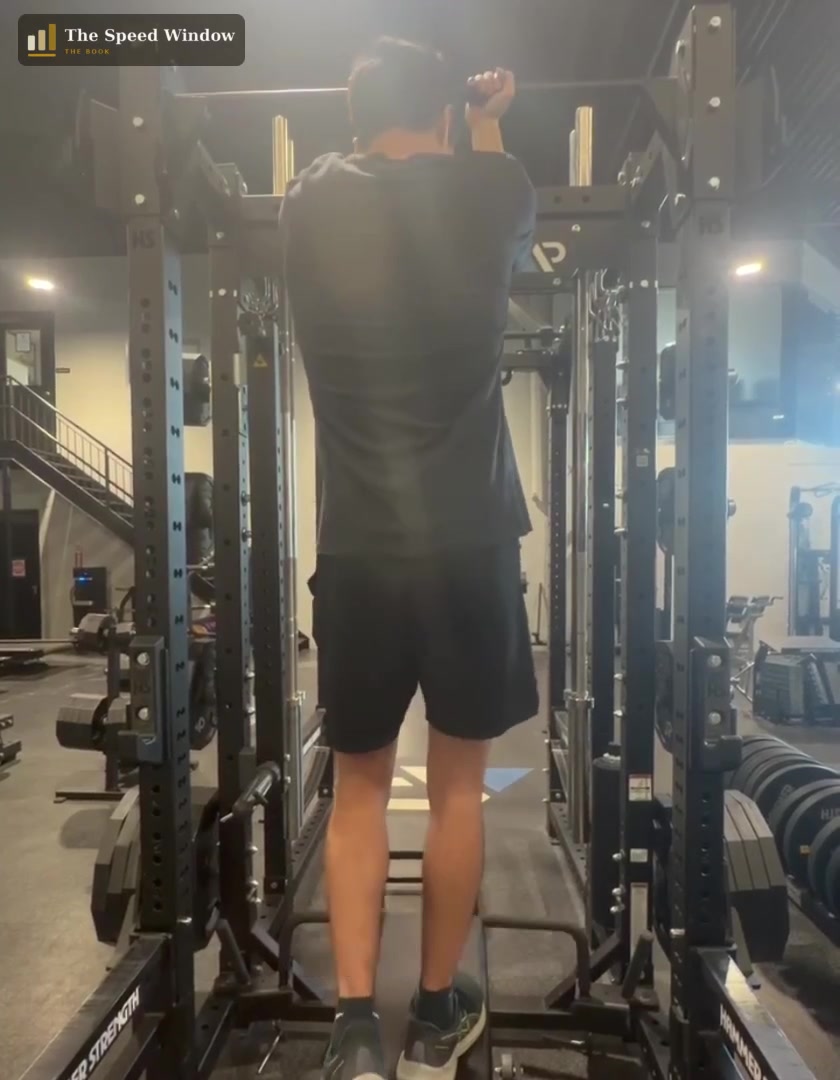
- Pull-Up (weighted in Force Window). The vertical pulling complement to the horizontal dumbbell row
Programming Notes
When and how to use this drill in a session.
The dumbbell row should appear in every Stabilization Window upper-body session. Pair it with the push-up progression or a pressing movement as the pulling counterpart. A 1:1 push-to-pull ratio is the minimum standard: ideally, programs in this window have slightly more pulling volume than pushing volume.
3 sets of 10 reps per side. Complete all reps on one side before switching. Start with the weaker side. Rest 60 seconds between sides. Progress the load when 3 × 10 is clean with full scapular retraction on every rep and no trunk rotation observed.
Watch for bilateral asymmetry carefully. A dominant side that rows significantly heavier than the non-dominant side is common and worth documenting. Equalize load across sides for the first training block. Do not allow the dominant side to race ahead.
Stabilization Window · Ages 12–15
Re-coordination through growth.
Growth disrupts movement patterns. This window focuses on re-establishing mechanics, building foundational strength, and preparing the body for the demands of force-based training.
Explore the Stabilization WindowEvery drill here comes from the book.
The Speed Window maps all three windows: what to train, when, and why.
Get the Book